
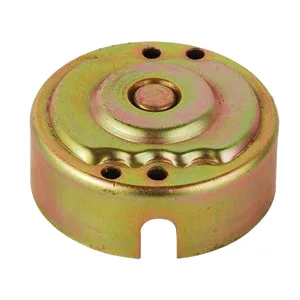
A DC motor cover is not a scaled-down industrial end cover – the motor architecture gives it its own set of jobs. Small bores, high volumes, brush-gear access and ventilation all shape the design. This page sets out what changes when the motor is DC, and how the stamping route is tuned for it.
What the cover does on a DC motor
On a brushed DC motor, the two covers do different work:
- Commutator-end cover. Often carries the brush holders or brush access, so it needs piercings and bosses positioned to the commutator datum – not just to the outer envelope. In-die tapping keeps those holes tied to the die datum.
- Drive-end cover. Carries the bearing and usually the mounting flange. Bearing-bore size and spigot runout are the two named checks, measured at first article and gauged on production runs.
- Both covers close the magnetic circuit path clearance and keep contamination out of the commutator gap – a dust path that a stamped shell must not offer.
Volume economics of the DC cover
DC motors are bought in the tens of thousands, and the cover is priced accordingly. Three levers dominate unit cost:
- Strip layout. Blank nesting on the coil decides material utilisation – often the largest cost item. We plan the strip so scrap is engineered out, not trimmed off later.
- One-pass completion. Progressive dies that blank, form, pierce and tap in one pass remove handling steps; every handling step on a small part costs more than the press seconds.
- Tooling amortisation. With annual volumes in the tens of thousands, a full progressive die amortises to a negligible per-part figure; below that, a simpler two-stage route is usually the honest quote.
Design details that matter at small scale
- Ventilation slots. Sized and placed for the cooling air path; pierced and deburred in-die so no burr sheds into the motor later.
- Cable and brush-access openings. Positioned to the commutator datum; where the opening edge needs stiffness, a lanced-and-formed lip is drawn in the same hit.
- Small bearing bores. On bores under roughly 20 mm, machining after drawing is often faster and more accurate than pushing the die to hold them – and it keeps the die simpler.
- Flatness for gasketed covers. Fan covers and sealed covers need a flat flange; drawn flanges are checked and, where needed, sized in a short calibrating hit.
Materials and finishes for DC duty
Carbon steel SPCC / DC01 with zinc plating is the volume default; electrophoresis over plating for humid duty; 304 stainless steel where the environment is aggressive and volume justifies the material premium. Finishes are locked to the drawing revision, so repeat orders match the sample without a re-decision.
Quality system
ISO 9001 certified production, mill certificates per heat, CMM first-article report, and sampling-plan inspection per batch. Deviations are reported before shipment rather than found on your assembly line, and the manufacturing record is archived with the drawing revision that produced it.
Sizing the draw for a part like this — reduction per station, ironing allowance, flange width — is covered step by step in our deep drawn covers guide.
Small-bore covers: why the pilot and the vent share one feature
On a small DC motor cover there is barely room for the pilot that locates the part, let alone a separate vent, so we often combine them: a shouldered boss that centers the cover and carries a breather cross-drill. This is cheaper than two features and tighter than adding a vent later, because the two are born from one operation. The risk is that the breather drill breaks into the pilot bore and weakens the locating surface, so we set the drill depth from the pilot and verify it on the first article rather than trusting the program. The result is a small cover that locates, breathes, and seals from a single drawn-and-drilled feature instead of three separate ones.
Burr control on the edge that faces the rotor
The inside cut edge of a small DC cover sits close to the spinning rotor, and a lifted burr there is a spark source and a noise source. We deburr that edge as a standard operation and give it a light break, then check it under magnification on the first article because the eye alone misses a hairline lip. On the lead-exit slot we radius the corners so the insulation is not nicked every thermal cycle. These are small operations with a large effect on motor life, which is why they sit in the routing and not in the inspection note.
Volume economics at small size
Small DC covers reward tight tooling because the part count is high and the piece price is low, so the die that holds the pilot true pays for itself quickly. We show the per-part saving against a welded alternative so the buyer sees the crossover volume.
Specifications
| Item | Metal stamping DC motor cover |
|---|---|
| Brand | AUNOV |
| Designing | Quotation follows the print, not a catalogue – samples are reverse-measured into a controlled drawing; the same drawing is used for every repeat order. |
| Tooling | Die design and toolmaking stay in house, so a die can be re-cut against the approved drawing, and maintenance is tracked against the part number. |
| Samples | Samples are issued for approval before the run, and production starts only after written sign-off. |
| Materials | Materials held include carbon steel, 304 / 316 stainless steel, aluminium and brass; material substitutes are proposed only with your written approval. |
| Surface finish | Natural, plated or coated – the print decides, and the agreed finish is logged; the finish is inspected with the dimensional report on the first article. |
| Processing | Multi-stage deep drawing with interstage annealing, trimmed and pierced in following dies; first articles verify the whole flow before the run is released. |
| Equipment | 5-250 T mechanical presses, 250-500 T hydraulic presses and annealing furnaces in line; first articles and batch samples are checked on the CMM. |
| Tolerance | +/-0.03 mm on turned secondary features, +/-0.1 mm on as-drawn walls; dimensional reports accompany the first article. |
| Delivery terms | FOB, with DDP offered for EU and US addresses, payment by T/T or L/C, quoted in USD or EUR; repeat orders reuse the approved first article. |
Related Products
Frequently Asked Questions
What does this cover do on a DC motor besides close it?
It usually locates something. The cover frequently carries a pilot that centres the assembly, holds brush gear or the commutator end in position, and on steel versions contributes to the magnetic return path. It also manages what happens to brush dust and to cooling air. Treating it only as a lid is why covers arrive dimensionally correct and still assemble badly.
What actually drives unit cost when these are made by the tens of thousands?
Three levers dominate at that volume. Material utilisation, because the blank layout decides scrap on every piece. Cycle rate, which follows how many operations the tooling needs. And anything requiring a second handling step, since leaving the press line costs far more per part than forming it did. Tooling amortisation is real but usually secondary at this quantity.
Why do the pilot and the vent end up sharing one feature?
Because there is nowhere else to put them. On a small bore cover there is not enough circumference to give the locating diameter and the air opening separate space, so one feature carries both jobs. That means it has to satisfy centring accuracy and airflow at the same time, and each requirement constrains how the other can be met.
Which details stop scaling down as the cover gets smaller?
Everything does not shrink together. Wall thickness has a floor set by forming rather than by scale, radii cannot follow the part down indefinitely, and the punches that make small features have their own strength limits. Absolute tolerances also stop reducing in step with the part size, which is where small covers tend to become disproportionately expensive.


Request a Quote for This Part
Send a drawing or sketch — get material advice, tooling cost and a per-piece price within 24 hours (working days).