
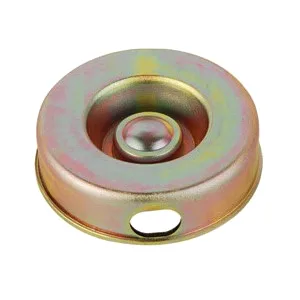
Aunov Tech manufactures the Stamped Electric Motor Cover from coil to finished surface on one floor: drawing presses, a die toolroom, CNC turning and a climate-controlled inspection room. This page is written for purchasing engineers comparing suppliers – what actually separates a cover manufacturer from a trader, and which questions to ask before you send a print.
Manufacturer or middleman: six checks
Most “motor cover manufacturers” found through search are trading companies. The difference is not a slogan – it is visible in six concrete places:
- Die tooling on site. Ask who cuts and maintains the drawing die. If tooling is subcontracted, every revision loop passes through a third party and lead times double. Our toolroom designs, wire-cuts and maintains dies under your part number.
- Press range matched to the part. Deep drawn covers need staged drawing with intermediate annealing for anything beyond roughly a 2:1 ratio. A shop with only cut-and-curl stamping presses will quote it anyway – and fail at the sample.
- First-article discipline. A real manufacturer measures the first article on a CMM against your print and issues the report before production starts, then gauges production batches back to the signed sample.
- Revision handling. Drawing changes should be re-quoted once, in writing, before they are made – not silently absorbed into a batch that no longer matches the approved sample.
- Traceability. Mill certificates per heat, process settings archived with the part number, and a reorder that is a repeat – not a new development.
- Secondary machining in house. Bearing bores and spigots that need better than the as-drawn ±0.1 mm are turned to ±0.03 mm. If turning is outsourced, concentricity between the drawn shell and the machined seat is nobody’s responsibility.
What the press floor looks like for this part
A stamped motor cover for volume production runs from coil: the strip is fed through a progressive die that blanks, forms and pierces in sequence, with in-dine tapping where hole position matters. Mechanical presses from 5 to 250 T cover small and mid covers; hydraulic presses from 250 to 500 T take the deep or large envelopes that need slower, controlled drawing with in-line annealing between stages.
Because die work, pressing, turning and inspection sit on the same floor, a feasibility question is answered on the shop floor the same day – not in a week of emails with a tooling vendor.
The questions we will ask about your print
A useful manufacturer pushes back on drawings early. Expect questions like these at quotation:
- Which faces actually mate – bearing bore, spigot, flange? Machining only those keeps cost down; specifying the whole envelope ±0.03 mm does not improve the motor.
- Is the corner radius at least 4× sheet thickness? Tighter radii are possible, but they raise draw force and thin the corner.
- What is the duty environment – indoors, under-hood, washdown, outdoors? It decides carbon steel with zinc plus e-coat, or 304 stainless steel as-drawn.
- Annual volume and call-off pattern. Progressive tooling pays for itself at volume; for low volumes a simpler single-stage route is usually the honest answer.
Quality system behind the part
Production runs under an ISO 9001 certified system. Incoming stock is verified against mill certificates, the first article is CMM-measured against your print, and production batches are inspected on the sampling plan agreed at approval. Part-specific checks on a motor cover: bearing-bore size and spigot runout measured at first article and gauged on every run. Torque, leak or pressure testing is added to the plan where the assembly demands it, with certificates in the shipment file.
Commercial terms
Tooling is quoted as its own line and held under your part number. Delivery is FOB as standard, with DDP offered for EU and US addresses; payment by T/T or L/C, with D/P accepted on repeat business. Call-off schedules are supported so you do not have to take a year’s volume in one shipment.
Drawing a cover like this is a chain of decisions — draw ratio, wall thinning, radii and trim. Our deep drawn covers design guide works through each of them with worked numbers.
Reading a supplier sample report before you commit
A motor-cover quotation is only as good as the first-article report behind it, so we hand the buyer the FAI with the quote rather than after the order. The report shows the pilot diameter, the bolt-circle truth, the wall thickness at the draw corners, and the flatness of the mounting face, each against the print tolerance. We point to the two or three characteristics that actually decide whether the cover fits the motor, because a twenty-page report that buries the pilot tolerance is worse than a short one that surfaces it. A buyer who can read the sample report can trust the production parts, and a buyer who cannot is exactly the one we want to educate before tooling is cut.
Tooling ownership and what it means for your program
The die that makes a cover is specific to one shape, so we are explicit about who owns it. Customer-owned tooling stays put and is returned on request; our-owned tooling is amortized into the piece price and the buyer is not hostage to a single shop. Either way the tool record, the setup sheet, and the last good sample travel with the program so a reorder two years later reproduces the same part. We would rather state the ownership plainly than let it become a surprise when a second source is needed or a program moves.
Specifications
| Item | Stamped Electric Motor Cover Manufacturer |
|---|---|
| Brand | AUNOV |
| Designing | Send drawings, or send a sample to be measured – DFM notes are returned before any tooling is cut; the approved drawing is kept as the controlled master. |
| Tooling | Tooling is built and held under your part number, so no tooling step is outsourced, and first-article timing is measured from the tooling start date. |
| Samples | Samples are issued for approval before the run, so the approved first article becomes the gauge reference, and later batches are gauged back to the signed sample. |
| Materials | Carbon steel, 304 / 316 stainless steel, aluminium and brass are all held in stock; the final grade is fixed with the drawing review. |
| Surface finish | Natural, plated or coated as the print decides; the agreed finish is logged, and thickness and adhesion are checked on the first article. |
| Processing | Coil feeding and progressive die blanking, forming, piercing or in-die tapping, deburring, then plating. |
| Equipment | Mechanical presses from 5 to 250 T and hydraulic presses 250-500 T, with in-line annealing furnaces, backed by CNC turning centres and a climate-controlled inspection room. |
| Tolerance | +/-0.03 mm on turned secondary features, +/-0.1 mm on as-drawn walls; dimensional reports accompany the first article. |
| Delivery terms | FOB, with DDP offered for EU and US addresses, T/T or L/C, with D/P accepted on repeat business; call-off schedules are supported. |
Related Products
Frequently Asked Questions
Which six checks actually separate a maker from a trading company?
Six things are hard to fake. Dies designed and cut in their own toolroom rather than bought in. Press capacity matched to your part rather than merely quoted as large. Material certificates traceable past the supplier’s own paperwork. A maintenance history kept for each die. A first-article report the metrology department produced rather than copied. And a sample whose reverse-engineered drawing agrees with yours. Any three missing usually means nobody has actually made the part yet.
What should a sample report tell you before you commit?
Not whether everything passed, but which characteristics were measured, with what instrument, how many pieces were sampled, and whether the hardest feature was among them. A report that measures eight easy dimensions and reports them green tells you nothing about the two features your assembly cares about. Reading the report critically is more useful than receiving it promptly.
Why does press capability have to suit your part rather than simply exceed it?
Capacity is a curve, not a number. Deep drawing needs controlled blank holder force through the stroke, so a large press with the wrong cushion arrangement will not form a part a smaller hydraulic press handles comfortably. Running a small part on a very large press also sets a cycle time the piece price has to carry. Matching the machine to the part is therefore a cost question as well as a capability one.
What belongs in writing before the first order rather than after?
Five things that are easy to agree and expensive to argue about later: who owns the tooling, what happens to unit price if volumes move, how material substitutions are approved, who maintains the die and at whose cost, and what evidence ships with each batch. Settling them at enquiry is what stops a first dispute from becoming a last one.


Request a Quote for This Part
Send a drawing or sketch — get material advice, tooling cost and a per-piece price within 24 hours (working days).