
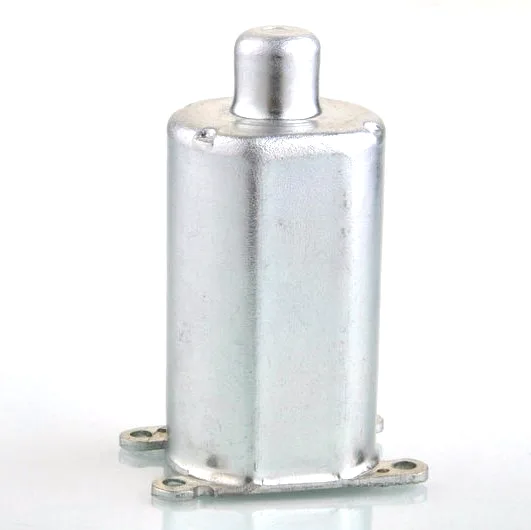
One shell, many variants: the platform shell strategy
A window regulator programme rarely ships a single motor. Long-wheelbase, short-wheelbase, left-hand, right-hand, and the export variants that follow – each needs a regulator motor that differs in cable exit, mounting ears, or harness clip, while the core shell is identical. The power window regulator motor shell is therefore best engineered as a platform part: one draw, one set of core tooling, and variant features added or suppressed at the trim and pierce stations. This page explains the platform approach from the shell supplier’s side, because the difference between a platform shell and five bespoke shells is measurable in both cost and lead time.
What the platform fixes, and what it leaves free
The platform shell fixes everything the draw produces: diameter, depth, wall, material, the magnet land, and the bearing seat. These are the expensive features – locked in tooling, shared across every variant, and therefore identical by construction. What stays free is everything the trim and pierce stations control: ear geometry, hole patterns, cable-exit position, and identification marks. The die architecture that enables this is insert-based – variant features live in changeable inserts, and switching variants is an insert swap measured in minutes, not a die rebuild measured in weeks. When we quote a regulator family, the platform proposal prices the shared draw once and the variant inserts per member, which is why the fifth variant costs a fraction of the first.
Variant management without chaos
Platform parts earn their savings only if variants stay traceable. Our shell variants carry a distinct stamped code – a shallow digit or notch pattern formed in a non-visible flange zone – so a housing returning from the field identifies its variant without a label. Production planning runs the same discipline: each variant has its own strip recipe (insert configuration, pierce pattern), and the press schedule groups variant runs to minimize changeovers. Buyers should ask any platform supplier how variants are coded and how a mixed-shipment is prevented; the answer separates organized platforms from hopeful ones.
The common-shell trap and how to avoid it
Platform thinking has one classic failure: a variant demand that breaks the common geometry. A new market wants a deeper shell; a service campaign needs an extra earth tab in a wall zone the draw never formed. The defence is designing slack into the platform at the start – draw depth with 10-15% of margin, flange width that can sacrifice a band, wall zones pre-qualified for later piercing. That margin costs a little material on every shell; it buys the ability to answer a variant request in weeks. Regulator programmes that skipped the margin have paid for it with an emergency re-draw, which costs more than the margin would have across the whole programme.
Volume economics of the platform shell
The platform’s arithmetic is simplest at the die level: one draw die amortized across all variants instead of five, cutting tooling per variant by 60-80%. Material follows – the common blank means coil purchasing at family volume with its price breaks. And quality infrastructure consolidates: one wall-map procedure, one SPC set, one first-article template applied to every variant. The piece price per variant then reflects only what genuinely differs, which is the honest price structure a sourcing team can defend internally.
What we need to quote the platform
The variant list with what differs per variant (a table beats five drawings for the first review), the common drawing or the target envelope, volumes per variant, and any known future variants – the margin discussion above needs that forecast. We return a platform proposal showing shared tooling, per-variant insert costs, and the piece-price ladder. First articles per variant follow die approval staggered over 2-4 weeks, since the variant inserts sample faster than the shared draw.
Platform across two motor suppliers, and what that costs
Can you platform a shell across two motor suppliers?
Geometrically yes – the shell does not care who winds the armature. Commercially it requires the interface data from both, and the agreement should name who owns interface changes. We have run it; the data-sharing clause matters more than the tooling.
Our variants differ in depth, not features – still platformable?
A depth difference is a draw change, not an insert change, so a two-depth family is two platforms sharing trim tooling. The quote will show the shared portion honestly – it is usually still worth it.
How late can a variant be added?
Within the fixed geometry, indefinitely – that is the point of insert-based variants. Outside it, the margin discussion returns, which is why we ask for the forecast at kickoff.
Automotive Motor Components is the parent range for parts like this one; the overview page gathers the tooling logic, finishing options and tolerance notes that apply across the family.
Specifications
| Item | Power window regulator motor shell |
|---|---|
| Brand | AUNOV |
| Designing | Quotation follows the print, not a catalogue – DFM notes are returned before any tooling is cut; changes are priced before they are made. |
| Tooling | Our toolroom covers die design, wire-cut EDM and maintenance, so die cost stays transparent, and first-article timing is measured from the tooling start date. |
| Samples | First-article samples ship with a dimensional report and material certificate, so the approved first article becomes the gauge reference, and the signed sample is kept for future reorders. |
| Materials | Carbon steel (SPCC / DC01), 304 / 316 stainless steel, aluminium, brass and copper – the grade is matched to the duty of this shell. |
| Surface finish | Phosphating first for coating adhesion, then powder coating, e-coating or zinc plating; chrome and nickel are reserved for visible faces. |
| Processing | Blanking, multi-stage deep drawing with interstage annealing, trimming and piercing, coining, then finishing. |
| Equipment | Mechanical presses 5-250 T, hydraulic presses 250-500 T, an in-line annealing furnace, and CNC turning for secondary work. |
| Tolerance | +/-0.01 mm to +/-0.03 mm on controlled dimensions, with CMM reports and capability data for critical features. |
| Delivery terms | FOB, CIF or DDP per Incoterms 2020, T/T or L/C, with D/P accepted on repeat business; call-off schedules are supported. |
Related Products

Request a Quote for This Part
Send a drawing or sketch — get material advice, tooling cost and a per-piece price within 24 hours (working days).