
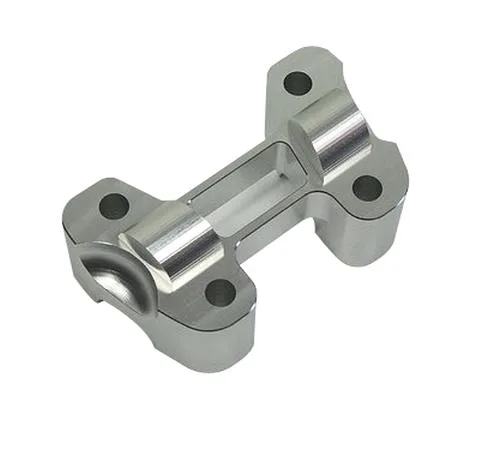
A sanitary fitting is not defined by being made of stainless steel. It is defined by one requirement that changes every other requirement on the page: the fluid path has to be cleanable, and cleanable means the interior geometry has to allow a cleaning tool to pass through it and see everything.
That single idea explains the sanitary clamp, the ferrule, the absence of threads in the flow path, the specific internal radii, and the surface finish requirement – and it explains why a sanitary fitting’s cost and its lead time are what they are.
What “cleanable” actually requires
There is a formal definition in the sanitary design world, and it is worth knowing because the whole industry is built around it. A passage is cleanable if a cleaning implement of a defined diameter – typically a brush or a pig – can pass through it, and if every internal surface it passes is exposed to the cleaning action. Three consequences, and each one is a design requirement.
- The passage must have a minimum internal diameter throughout. No internal step, no shoulder, no ledge that reduces the bore anywhere along the path. A sanitary fitting with an internal shoulder is not cleanable through that shoulder, and it is not just a matter of convention – the shoulder is where product accumulates and where a bacteria film establishes.
- Every internal corner must be radiused. A square internal corner cannot be cleaned by a tool because the tool cannot reach into it, and it is precisely where a soil film forms. This is why sanitary fittings have visibly generous internal radii everywhere, and why they look the way they do.
- The passage must be inspectable. This is the requirement that is hardest to satisfy and it is why a sanitary fitting’s design is dominated by how it comes apart. If a fitting cannot be taken apart, the interior cannot be inspected, and a process that cannot be inspected cannot be validated.
That third point is the one that makes sanitary fittings cost what they do, and it is worth understanding before comparing a sanitary fitting’s price with a standard fitting’s. A sanitary fitting is a part that is designed to be dismantled with tools, repeatedly, without damaging its sealing surfaces, and to be put back together with a reliable seal. That is a substantial amount of engineering in a small piece of metal.
The seal, which is where the sanitary design spends its money
The clamp and ferrule system is the heart of it, and there are three details that matter.
- The ferrule’s sealing geometry. In the common single-ferrule design, a ferrule sits in the fitting’s recess and is compressed by the clamp. The ferrule’s face has a raised or shaped profile that presses against a flat sealing face on the fitting. The design has to produce a reliable seal across a wide range of clamp torque and across temperature cycling, and it has to do it without the sealing face becoming distorted.
- The sealing face’s flatness and finish. This is a real specification and it is the tightest dimensional requirement on the fitting. The face has to be flat, it has to be clean, and it has to be smooth enough that the elastomer seal conforms. Where the design uses a metal-to-metal seal rather than an elastomer, the face’s finish becomes even more critical because there is no conforming element.
- The recess geometry and the ferrule’s seat. The ferrule has to seat positively and locate repeatably, and the clamp has to draw it straight. A design where the ferrule can skew will leak, and the skew will happen on a fitting whose face is slightly out of flat – which is exactly the reason the face’s flatness is specified tightly.
The practical consequence: on a sanitary fitting, the sealing face’s flatness is more important than the thread, and on most drawings it is specified loosely. Where a product is sensitive to it – a bioprocess product, a pharmaceutical fluid, a high-purity chemical – the face’s flatness and its finish should be stated as functional requirements with a verification method.
The thread, and where it is allowed to be
A sanitary fitting’s clamp nut has to be removable, and removable fasteners need threads. The rule that makes sanitary fittings different is that the thread must not be in the fluid path.
- Threaded connections that break into the product are non-compliant on a hygienic installation, because the thread’s geometry is a crevice and a dead leg, and because product can be trapped in the nut’s threads. This is why a sanitary system is clamped rather than threaded where the connection is wetted.
- Where threads are used on the outside of a spigot – on a hose connection, a clamp nut’s captive nut, or a tank fitting – the rule is that they must be smooth, with no crevice that can hold product, and they must be drainable so that a horizontal run will not trap a column of liquid.
- The spigot’s outside diameter, its length, and its end geometry are all specified to standard sizes so that standard clamps and gaskets fit. On a sanitary fitting this is not interchangeable across manufacturers and the standard has to be stated, because a part that is dimensionally within a general tolerance and outside the clamp’s tolerance will not seal.
Internal geometry, and the drainability question
Three requirements combine here, and they are related.
- No dead legs. A dead leg is any section of the passage that is not swept by the flow. Product stagnates in a dead leg and it is a legitimate finding in a validation audit. On a fitting, dead legs are created by internal steps, by unvented pockets, and by the gap between a seat and a body. So a sanitary fitting’s internal geometry is designed so that the entire internal volume is part of the swept path.
- The bore must be constant through the flow path – no reduction, no step, so that the passage is uniform for cleaning.
- Drainability, where the fitting will be installed horizontally. A fitting should not have a pocket where liquid collects. That means the passage’s low point should be drainable, which on a turned part means the internal geometry has to be designed around where the liquid will sit in a typical installation. This is an installation question as much as a design one and it is worth asking about.
On a turned part specifically, the drainability question leads directly to how the part is oriented and how it is supported. A fitting designed to be installed with its bore horizontal will collect liquid in whatever the lowest internal feature is; a fitting designed to drain will have its internal geometry arranged so that the lowest point is the opening.
Surface finish, and the two different answers
Natural, plated or coated per the print, with the finish inspected alongside the dimensional report on the first article. On a sanitary fitting the surface finish requirement differs sharply between the inside and the outside, and the reason is worth stating plainly.
- Inside: a defined roughness, and it must be cleanable. A high-polish internal surface is easy to clean because there is nowhere for soil to sit. A rougher surface is harder. So the internal finish requirement is not cosmetic – it is a cleanability requirement, and the convention and the measurement method matter.
- Outside: appearance and corrosion resistance. The external surface is not wetted, so its finish is conventional. But note that a polished external surface on a sanitary fitting is often specified for cleanability of the exterior – a splash that sits on a rough exterior is a soil reservoir even if the product side is clean.
- Passivation is the default on stainless steel, and on a hygienic application it is not optional. Polishing and machining remove the passive film, and the part has to be passivated to restore it.
- Plating is generally avoided on wetted parts, and where it is used it is because of a specific requirement. A plated wetted surface is a coating that can be scratched, and a scratch on a wetted surface is where corrosion starts and where a cleaning agent can attack.
Material, and the grade question
Carbon steel, 304 and 316 stainless steel, aluminium and brass, with the final grade fixed at the drawing review. On a sanitary fitting the grade is decided by the product, not by the process, and the question that decides it is the chloride question plus one more.
- 316L is the normal answer for a wetted stainless steel part, because cleanability and cleaning agents mean chloride exposure, and because 316L resists it. This is a case where 304 is genuinely the wrong answer and the reason is the cleaning regime rather than the product.
- The L grade, where there is any welding or heat input in the fabrication. A hygienic part is often welded and polished, and 316 rather than 316L risks sensitisation in the weld’s heat-affected zone – a corrosion initiation site inside a surface that is supposed to be the cleanest one on the system.
- Surface condition as delivered, which is a real specification on hygienic parts: the surface must be free of embedded free iron, free of grinding burrs, and free of polishing residue. Embedded iron from a shared workshop will rust and it will do it on the wetted surface, and this is a well-known cause of rejection.
A sanitary fitting’s flagged dimensions are the faces cleanability depends on
+/-0.02 mm general machining, tighter on flagged dimensions, dimensional reports accompanying the first article. On a sanitary fitting the flagged dimensions are the sealing faces and the geometry that the cleanability requirement depends on.
- The sealing face’s flatness and its finish, as the primary requirement, verified by a stated method.
- The spigot’s diameter, length, and end geometry, to the clamp’s standard rather than to a general tolerance, because the clamp and the gasket must fit it.
- The internal bore’s diameter and its consistency through the flow path, including that there is no step – which is a positive requirement rather than a tolerance.
- Internal radii, specified as a minimum rather than as a general fillet note.
- Concentricity of the bore to the spigot’s OD and to the sealing face, because a non-concentric bore in a sanitary fitting produces a flow path with a dead zone at one side.
- Concentricity of the sealing face to the bore, which is the same requirement stated in the way that matters for the seal.
- General dimensions at a general band.
Passivation is an operation with a date, not a line in a report
- Sealing face flatness and finish, measured and reported, on every part – this is the item that cannot be sampled.
- Passivation recorded as an operation with a date, where specified, because it is the process that makes the part corrosion-resistant.
- Internal surface finish, measured internally where possible and inspected otherwise – and inspected for burrs, which are a cleanability defect rather than only a fit defect.
- Bore diameters through the flow path, and a positive check that there is no internal step.
- Internal radii verified against a stated minimum, visually against an approved standard.
- A functional clamp test on a sample: fit the mating clamp and gasket and confirm a leak-free assembly at the specified torque. This is the only inspection that tests the specification the customer actually cares about and it takes seconds.
- Surface cleanliness verification – on a hygienic part this is a real inspection, usually by a visual check under adequate lighting with an agreed standard, and it is the item that catches embedded iron and polishing residue.
How the fitting will be cleaned
How is this fitting going to be cleaned – CIP, SIP, manual, or a combination? The answer changes the design and the specification more than anything else about a sanitary fitting. A part that will be steam-sterilised in place has different thermal mass requirements and a different drainability requirement from a part that will be manually cleaned and drained, because a part with a deep cavity that cannot be drained will not sterilise. A part that will be cleaned by a fixed-size pig or brush has a hard minimum bore that the design must respect and that the customer’s cleaning equipment defines. And a part in a pharmaceutical application has documentation and material-traceability requirements that a part in a food application does not. Asking this before the drawing is released costs one sentence, and it establishes the minimum bore, the drainability requirement, the internal finish, and in some cases whether the part needs a specific kind of certification paperwork.
Our CNC Machining Parts range is where this part sits. The cnc machining parts pages carry the process notes, common materials and inspection points behind every product in the family.
Specifications
| Item | Stainless Steel Sanitary CNC Turned Spools |
|---|---|
| Brand | AUNOV |
| Designing | Driven by your drawing or a physical sample – unusual walls, threads or tolerances are feasibility-checked first; the approved drawing is kept as the controlled master. |
| Tooling | Die design and toolmaking stay in house, so tooling lead time stays under our control, and ownership is confirmed on the quotation. |
| Samples | Prototype and pre-production samples are provided against the drawing, so any deviation is corrected at sample stage, and later batches are gauged back to the signed sample. |
| Materials | Carbon steel, 304 / 316 stainless steel, aluminium and brass are all held in stock; the final grade is fixed with the drawing review. |
| Surface finish | Natural, plated or coated – the print decides, and the agreed finish is logged; the finish is inspected with the dimensional report on the first article. |
| Processing | CNC turning from bar or billet, concentricity held across operations; every stage is logged against your part number. |
| Equipment | CNC turning centres with bar feeders and 3-/4-axis machining centres, with in-house toolmaking to keep dies and fixtures maintained. |
| Tolerance | +/-0.02 mm general machining, tighter on flagged dimensions; dimensional reports accompany the first article. |
| Delivery terms | FOB, CIF or DDP per Incoterms 2020, T/T or L/C, with D/P accepted on repeat business; sea or air freight is quoted to your door. |
Related Products


Request a Quote for This Part
Send a drawing or sketch — get material advice, tooling cost and a per-piece price within 24 hours (working days).