
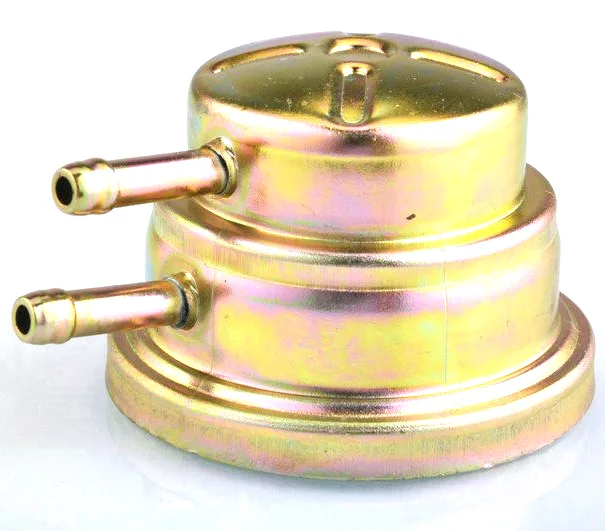
A two-tier housing has a divider, and the divider is where the design lives
A two-tier drawn housing with twin pipe stubs is a drawn case with a partition inside it and two tubes passing through the wall. Both features look like additions to a simple drawn box, and both of them are where the difficulty is. The partition is a structural feature that a draw cannot easily produce and that changes how the two cavities are formed. The pipe stubs are penetrations of a pressure or fluid boundary, and every penetration is a potential leak path.
We deep draw on maintained presses with blank size and lubrication logged per run, and in-process checks sit between stages rather than only at the end, on a press shop running 5-250 T mechanical and 250-500 T hydraulic presses with annealing ovens on site, and first articles and batch samples checked on the CMM. Drawn diameters to +/-0.05 mm with tighter bands confirmed against the drawing, and dimensional reports accompany the first article. Nickel 200 and 201 and nickel-plated steel in 0.8-4.0 mm are held, selected where conductivity and oxidation resistance both matter. Plating, coating or polishing to suit the drawing, with masking and laser marking available where needed. This page is about the partition and the penetrations, which are the two features that make this part more than a box.
The partition, and why it is not simply a formed shelf
A two-tier housing needs something between its tiers, and the options each have consequences:
- A drawn partition – formed from the housing’s own material in the same drawing operation. This is the cheapest and the cleanest, and it is what a two-tier housing normally uses. It has two requirements: it has to be strong enough to carry whatever sits on it, and it has to be positioned accurately enough that the two tiers are usable.
- A separate partition panel assembled into the housing. This gives control of the partition’s flatness and its fit, and it allows the partition to be a different material – which is useful if one tier needs to be insulated or shielded. It adds an assembly operation and a joint, and a loose partition in a housing that is shaken or transported will rattle and can damage the housing’s interior features.
- A machined or turned internal feature as a secondary operation. This gives the best accuracy and the best flatness, and it is the right answer where the partition has to be a sealing surface or a heat-transfer surface. It costs a secondary operation.
Whatever the route, three requirements on the partition itself:
- Flatness. A partition that is dished will not seat anything flatly, and on a tier that holds a component the component will sit on its edges. On a drawn partition this is controlled by the forming and is worth a callout.
- Deflection under load. A drawn partition spanning between two walls is a beam, and it will deflect under any real load. The deflection moves everything on it, and if anything on it is a sealing feature, the deflection opens the seal. This is a structural calculation and it is worth doing rather than discovering.
- Its position relative to the housing’s interior. The partition’s height and its position relative to the stubs and the walls are what define the two tiers’ usable volumes. Where a tier has to hold a specific component, the internal volume is a functional requirement.
The pipe stubs, which are penetrations of a fluid boundary
Twin pipe stubs passing through the housing wall are the part’s most demanding features, because each one is a place where the wall has to be penetrated and still hold. Four requirements on each, and they are the same four whether the housing carries fluid or gas:
- How the penetration is made. A pierced hole with a fitting screwed into it, a drawn boss with a threaded insert, a welded fitting, or a brazed fitting. Each has a different leak path and a different strength. A pierced hole in a thin wall with a fitting screwed straight into the sheet is the weakest of these and is worth avoiding on any pressured boundary.
- Reinforcement of the wall around it. A hole in a wall removes the material that was carrying the pressure load around it, so a wall with two holes is weaker than a plain wall of the same thickness. The reinforcement – a drawn boss, a thicker local section, a flange – is what brings the wall back to its pressure capability, and where the housing is a fluid boundary this should be a calculation rather than a detail.
- Sealing. The seal is at the fitting, not at the wall, and the wall’s surface around the penetration has to be able to support a seal. A drawn wall’s surface carries draw marks and is not a sealing surface, so the sealing has to be on a machined face or on a formed boss. This is a process decision with a functional consequence.
- Alignment. Where the two stubs have to line up with something else – a customer’s pipework, a manifold – their positions and their angles are functional tolerances. Two stubs that are nominally identical but a degree apart in angle will not connect.
Nickel, and why it is specified on this part
Nickel 200 and 201 and nickel-plated steel in 0.8-4.0 mm are held, selected where conductivity and oxidation resistance both matter. Nickel on a housing with pipe stubs is very likely driven by one of three reasons, and each has a different consequence:
- Corrosion resistance in a specific medium. Nickel is stable in a wide range of acids and alkalis and in many chemical environments where steel would not survive. If this housing carries a caustic, an acid, or a halogenated fluid, nickel may be the only reasonable choice, and the specific medium and its concentration should be on the drawing.
- Oxidation resistance at temperature. Nickel forms a protective oxide and resists oxidation well at elevated temperature, which matters if the housing carries a hot fluid or sits near a hot process. It is one of the reasons nickel is used in heat and process equipment.
- Conductivity where the housing is an electrical path. Nickel is a good conductor – not as good as copper or silver, and notably worse than aluminium at about a fifth of aluminium’s conductivity – but it combines conductivity with corrosion resistance in a way that aluminium does not. Where the housing has to conduct and resist corrosion, nickel is the compromise.
And the specific grades, which are not interchangeable: Nickel 200 is commercially pure and has better electrical and thermal conductivity and better resistance to reducing acids and caustic solutions; Nickel 201 has a lower carbon content, which makes it better at high temperatures and eliminates the risk of carbon deposition in some chemical service. Choosing between them is a service decision. Nickel-plated steel is a different product entirely – a steel part with a nickel coating, where the pressure boundary is the steel and the nickel provides the surface. That distinction is important: a nickel-plated steel part’s corrosion resistance depends entirely on the plating’s integrity, and on a fluid boundary a pinhole is a leak path and a corrosion initiation site.
Drawing, forming and the process sequence
Two-tier housing with stubs is a multi-stage part, and the sequence matters:
- The main draw first, forming the housing’s body and its flange.
- The stubs as formed bosses, formed in a later stage – a drawn boss gives the penetration something to be made in and something for a fitting to seal against, and it is much stronger than a bare hole.
- The penetrations, pierced or drilled in the bosses. Where a stub carries a fitting that has to be sealed, the sealing face is machined, and that is a secondary operation.
- The partition, formed with the housing or assembled as a separate part, depending on the route chosen.
Mask every sealing face: the stubs, and the partition if it seals
Plating, coating or polishing to suit the drawing, with masking and laser marking available where needed. On this part:
- Mask every sealing face, which on this part means the stubs’ sealing faces and the partition’s sealing face if it seals. A coating on a sealing face changes its dimension and adds a layer that will not seal the same way.
- Nickel-plated steel needs care in the plating specification. The plating is the corrosion protection, so its thickness, its coverage inside the stubs, and its adhesion are all functional. Coverage inside a stub is a known weak point on a plated part, and a stub’s interior is a crevice where the plating will be thinner than on the outside.
- Bare nickel needs no plating and its surface is already corrosion resistant, so the finish on a solid nickel part is usually passivation or nothing – and the benefit of that is that no dimension changes.
- Laser marking is available and is useful on a part in a process environment where traceability across a batch matters.
Two tiers are frequently one part plus one
Eight things, and the first four are the ones that make the part functional rather than merely shaped:
- What the housing carries – the medium, its temperature, its pressure if any, and whether it is corrosive. This is what decides the material.
- Nickel 200 or 201, or nickel-plated steel, stated explicitly, because these are different products with different pressure and corrosion behaviours.
- Each stub’s position and angle, as true position and as an angle, against a named datum, and what they have to mate with.
- How each penetration is made and sealed, and the sealing face’s designation.
- The partition’s route – drawn, separate, or machined – and its flatness and its position.
- The partition’s deflection limit, if anything on it seals or locates.
- Internal volumes of both tiers, where the tiers have to hold defined contents.
- Which surfaces are masked, and whether dimensions apply before or after finish.
Do the two tiers need to be one part?
Do the two tiers need to be one part? A two-tier housing is frequently specified as a single drawn part because it is convenient, and it is frequently a single drawn part when two parts would be better – a drawn body plus a separate partition or a separate cover gives better access, better flatness, better sealing, and it makes the partition replaceable. The reason to keep it as one part is usually cost or the need for a sealed interior with no internal joint. Both are legitimate, and it is worth establishing which of them applies, because it determines whether the partition’s requirements are forming requirements or assembly requirements – and those are very different things to specify.
Our deep drawn covers guide puts numbers to the design decisions behind a part like this — draw ratio, wall thinning, radii and trim; the Precision Deep Drawn Parts pages collect the rest of the family.
Specifications
| Item | Deep Drawn Nickel Fuel Housing |
|---|---|
| Brand | AUNOV |
| Designing | Made to your 2D/3D drawings (PDF, DWG, STEP, IGS) – DFM notes are returned before any tooling is cut; revisions are re-quoted once rather than silently absorbed. |
| Tooling | Progressive and drawing dies are designed and built in house, so a die can be re-cut against the approved drawing, and maintenance is tracked against the part number. |
| Samples | Samples are issued for approval before the run, so the approved first article becomes the gauge reference, and later batches are gauged back to the signed sample. |
| Materials | Nickel 200 / 201 and nickel-plated steel, 0.8-4.0 mm; selected where conductivity and oxidation resistance both matter. |
| Surface finish | Plating, coating or polishing to suit the drawing; masking and laser marking available where needed. |
| Processing | Deep drawing on maintained presses, blank size and lubrication logged per run; in-process checks sit between stages, not only at the end. |
| Equipment | Press shop running 5-250 T mechanical and 250-500 T hydraulic presses, annealing ovens on site; first articles and batch samples are checked on the CMM. |
| Tolerance | +/-0.05 mm on drawn diameters, tighter bands confirmed against the drawing; dimensional reports accompany the first article. |
| Delivery terms | FOB, CIF or DDP per Incoterms 2020, T/T with deposit and L/C for larger runs; repeat orders reuse the approved first article. |
Frequently Asked Questions
Why is nickel specified for a fuel housing?
Nickel and its alloys resist the fuel, the vapour, and the temperature swing that a fuel boundary sees, where carbon steel would corrode and many aluminium grades would not hold up. It is specified for the fluid and the service life, not for cost, so the housing keeps its wall and its seal seats through the duty cycle.
How are the pipe stubs and the internal divider sealed on a nickel fuel housing?
The stubs are formed or machined penetrations located off the drawn shell datum, and any internal divider is part of the same drawn form rather than a loose insert. Sealing is on the stub face or thread and on the divider land, and each is verified because a fuel housing fails at a penetration long before the wall does.
What wall thickness can a deep drawn nickel fuel housing hold?
The wall is held by the punch-to-die gap and the ironing station, typically to a few hundredths of a millimetre on the critical faces and verified on the CMM. Because the part is a pressure and fluid boundary, the thinnest section after drawing sets the working limit, and that is stated on the drawing.
Can a two-tier nickel fuel housing be made as one drawn part?
Often yes – the two tiers are frequently one drawn shell with a formed divider, which avoids the seam and the alignment risk of joining two pieces. Whether one part earns its keep depends on the divider’s sealing duty; where it must seal, the single drawn form is the safer route.
Related Products


Request a Quote for This Part
Send a drawing or sketch — get material advice, tooling cost and a per-piece price within 24 hours (working days).