
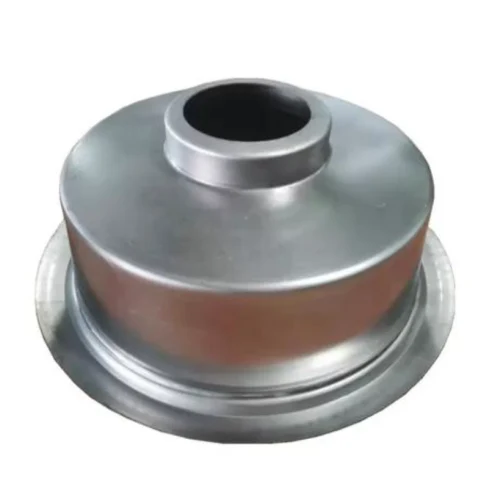
A blood analyzer liner is a fluid path, and it is cleaned and inspected like a medical device
A drawn analyzer liner cup, nickel-plated, sits in the fluid path of a blood analyzer. Everything that crosses it – sample, reagent, wash solution – meets its surface. That single fact makes this part a different category of product from the rest of this family, and it changes the requirements in ways that are worth being explicit about before anything is drawn.
We coil-blank and progressively draw, coining on the final station where the print calls for it, and every stage is logged against your part number, on 5-250 T mechanical presses and 250-500 T hydraulic presses with annealing furnaces in line, with in-house toolmaking keeping dies and fixtures maintained. Tolerance runs +/-0.05 mm to +/-0.1 mm across the part with wall thickness held to print, and capability is checked on the first article before the run continues. Stock covers carbon steel in SPCC and DC01 grades, 304 and 316 stainless steel, aluminium and brass, with the final grade fixed at the drawing review. Finish is selected from the drawing – plating, coating, anodising or passivation – with alternatives quoted with the quotation and samples approved in writing. This page is about the fluid path, the surface, and the four things that make a liner a medical-adjacent part rather than a drawn cup.
The fluid path sets the surface requirement
A liner’s interior carries biological samples and reagents, and four consequences follow:
- Everything left on the surface is a potential cross-contamination. A reagent residue, a cleaning chemical, a lubricant trace, or a particulate from the drawing process can carry between samples. On an analyzer that runs many samples, carryover is a correctness problem as much as a safety one, and it is a direct consequence of the surface condition rather than of the geometry.
- Drawing lubricant is the most likely contaminant. A drawn part is made with lubricant, and the interior of a deep drawn cup is exactly where a lubricant film will sit and where a cleaning process will have to reach. This is why a medical or analytical liner is normally specified with a cleaning and passivation requirement, and why the process route has to include it. A liner that is only rinsed will carry lubricant.
- Anneal oxide is a second contaminant. An annealed stainless steel part carries an oxide skin. On a wetted part, that oxide is a surface that is not the alloy and that can release particles. Pickling and passivation after the anneal is the normal answer, and it should be a stated requirement rather than an assumption.
- The interior surface finish affects flow and adhesion. A rough surface holds more residue and is harder to clean; a smooth surface is easier to clear and is easier to verify visually. Where a lining or a coating is applied downstream, the surface’s roughness directly affects adhesion, and a drawing-produced surface is not a controlled finish surface.
Nickel plating, and what it does in a fluid path
Nickel plating is specified on this part and it has real consequences in an analytical fluid path – some good, some requiring care:
- A smooth, hard, corrosion-resistant surface that is easy to clean and does not itself corrode. This is the reason it is chosen, and for a wetted stainless steel part it is a reasonable choice.
- Ionic contamination. This is the one that needs attention. Nickel is a known sensitiser, and a nickel surface in contact with a fluid – particularly one that is inhaled or absorbed rather than just touching skin – has historically been restricted in some applications and remains a consideration in others. Where the fluid is a reagent or a sample that is not for human administration the position differs from a direct-contact device, but it is a question worth raising at enquiry rather than a question to answer afterwards.
- Tin is often preferred for a wetted analytical part, because tin is inert, solderable, and does not carry nickel’s sensitisation concern. Where nickel is specified for appearance or for a specific reason, that reason should be recorded on the drawing.
- Coverage inside the cup is the practical problem. Plating a deep drawn cup’s interior is a barrel or rack operation, and the interior will be thinner than the exterior. On a fluid path, thin plating is thin corrosion protection, and a pinhole in the interior is where corrosion starts. Where the medium is aggressive, a thicker plate or a different system should be considered.
Geometry, and the cup’s own requirements
Beyond the surface, the drawn cup’s geometry carries four requirements that are functional in an analyzer:
- Volume calibration. A liner in an analyzer usually defines a sample volume, which means its internal volume has to be controlled – and internal volume is set by the drawn diameter and depth, both of which vary with the draw. A liner whose volume is out by a few percent will give a biased result, and the volume tolerance is a functional requirement derived from the analytical method’s tolerance.
- Wall thickness, held to print. On this part the wall is the part’s structure and it is also a thermal path. A thin wall changes with temperature and the sample’s temperature, which affects some analytical reactions. And a thin wall drawn unevenly is a wall that can vary in a way that changes the volume.
- The rim and its seal. Where the liner seals against the analyzer’s other components, the rim’s flatness and its concentricity are requirements – a rim that is not flat leaks, and a rim that is not concentric will not mate. This is where the tight band belongs.
- Cleanability. The geometry has to permit cleaning. A cup with a deep narrow interior, a sharp internal corner, or a re-entrant feature is hard to clean and hard to verify. Where a design has a feature that will trap residue, that is a review point rather than a detail.
Coining, and why it matters here
Coining on the final station where the print calls for it does three things on a liner, and all three are functional:
- It controls the rim’s flatness, which is the seal.
- It brings the wall’s thickness into a tighter band, which means the volume is more consistent from part to part – and volume consistency is the analytical requirement.
- It closes the surface’s porosity slightly, which is not a substitute for passivation but helps produce a more consistent surface.
A fluid path liner is judged on cleanability first
Stock covers carbon steel in SPCC and DC01 grades, 304 and 316 stainless steel, aluminium and brass, with the final grade fixed at the drawing review. For a fluid path:
- 304 stainless steel is the standard for an analytical liner. It is cleanable, corrosion-resistant, and takes a fine surface. It is the correct default for water-based reagents and aqueous samples.
- 316 stainless steel where the medium contains chlorides, salt, or is mildly acidic – which covers a surprising number of reagents. 316 is the right answer for anything saline and for many cleaning chemistries.
- Carbon steel with plating is used occasionally where cost dominates and the medium is not aggressive, and it is a compromise: the base metal is not corrosion resistant, so the part’s life is the plating’s life.
- Aluminium is unsuitable for most analytical fluid paths, and it is worth saying why: aluminium’s oxide is a poor barrier to many media, it can leach ions into a solution, and it will corrode in alkaline cleaning chemistries. It is used only where the liner does not contact the sample.
- Brass has a place in some analytical fittings but would generally not be specified for a sample-contacting cup.
A moulded polymer cup may be the cheaper part
Eight things, and on this part the first four are the ones that would be missing on a general liner drawing:
- What the cup contacts – the sample, the reagent, the wash, the atmosphere – and for how long. This determines the material and the surface.
- Whether the liner contacts anything that is administered to or inhaled by a person, because that changes the regulatory position on nickel and on any coating entirely.
- Internal volume and its tolerance, since that is the analytical requirement and it is derived from the drawn geometry.
- Cleaning and passivation requirements, stated as a process step with a verification method – not as “clean”.
- Nickel plating type and thickness, with its functional reason, and whether tin is an acceptable alternative.
- Rim flatness and concentricity at the tight band, since the rim is the seal and the locating feature.
- Wall thickness held to print, and where the minimum is.
- Cleanability requirements – the maximum internal corner radius, and any feature that will trap residue, called out for review.
Is a drawn metal cup right, or normally moulded?
Is a drawn metal cup the right answer, or is this part normally a moulded polymer liner? An analytical liner in a blood analyzer is very often a moulded plastic cup, for good reasons: it takes a complex internal geometry easily, it is disposable by design, it costs little, and it cannot corrode or contaminate a solution with metal ions. A drawn metal liner is justified where the fluid chemistry attacks polymers, where the liner is reused rather than disposable, where a rigid wall is needed for a measurement, or where the analyzer’s design is metal-bodied. If the part is disposable, a moulded cup is very likely the better answer and it is worth asking at enquiry – because the answer changes the part entirely, and it is a much better question to ask before the tooling is committed than after.
Choosing between drawing, machining and welding comes down to the shape of the part: the guide to deep drawn covers sets out where each route wins, and the overview page links through to the full Precision Deep Drawn Parts range.
Specifications
| Item | Deep Drawn Blood Analyzer Liner |
|---|---|
| Brand | AUNOV |
| Designing | Your drawing sets the part – DFM notes are returned before any tooling is cut; the approved drawing is kept as the controlled master. |
| Tooling | Our toolroom covers die design, wire-cut EDM and maintenance, so tooling lead time stays under our control, and the die remains dedicated to your part. |
| Samples | Samples are produced on the production tooling, so what you approve is what you get. |
| Materials | Stock covers carbon steel (SPCC / DC01), 304 / 316 stainless steel, aluminium and brass; the final grade is fixed with the drawing review. |
| Surface finish | Zinc, nickel or chrome plating, anodising, passivation or e-coat; alternatives quoted with the quotation, samples approved in writing. |
| Processing | Coil blanking and progressive drawing, coining on the final station where the print calls for it; every stage is logged against your part number. |
| Equipment | 5-250 T mechanical presses, 250-500 T hydraulic presses and annealing furnaces in line, with in-house toolmaking to keep dies and fixtures maintained. |
| Tolerance | +/-0.05 mm to +/-0.1 mm across the part, wall thickness held to print; capability is checked on the first article before the run continues. |
| Delivery terms | Terms are FOB by default, with CIF and DDP quoted on request and freight priced to your door. |
Frequently Asked Questions
Why is a blood analyzer liner treated like a medical device?
Everything that crosses it – sample, reagent and wash solution – meets its surface, so it is cleaned and inspected like a medical-adjacent part. Cleanability comes before any dimensional feature, and the interior surface finish is specified rather than assumed.
What does nickel plating do in the fluid path of a liner cup?
Nickel gives a hard, non-porous and cleanable surface that resists the reagents and wash chemistry and protects the base metal from the fluid. The plating thickness and adhesion are checked on the first article.
Which materials are used for an analyzer liner?
Carbon steel, 304 and 316 stainless steel, aluminium and brass are held in stock, with the final grade fixed at the drawing review; 316 is used where the duty needs the extra corrosion resistance. Tolerances run from +/-0.05 mm to +/-0.1 mm.
How is a fluid path liner quoted and verified?
Coining on the final station sets the critical face, and capability is checked on the first article before the run continues. The typical minimum order is 1,000 pieces with a 24-hour quotation.
Related Products


Request a Quote for This Part
Send a drawing or sketch — get material advice, tooling cost and a per-piece price within 24 hours (working days).