
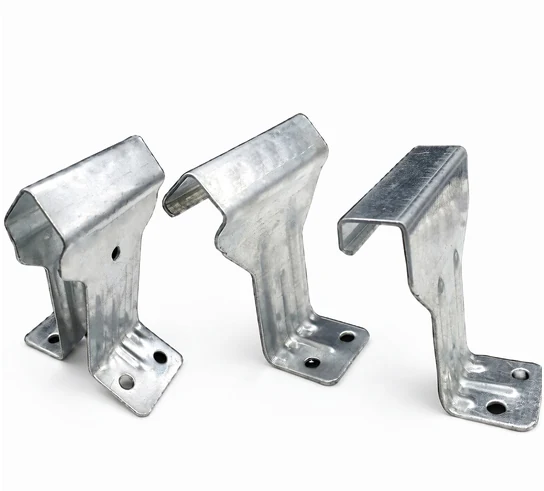
The difference between brackets and clips is whether the part is allowed to bend
Custom stamped brackets and clips look like two versions of the same product, and in a drawing they are two different engineering problems. A bracket is a rigid part: it holds its shape, it carries load through its material, and its dimensions at the end of production are its dimensions in service. A clip is a spring: it is supposed to deflect, its retention force is its product, and its dimensions are only half the specification – the other half is how it behaves when you push it. Designing a clip as if it were a bracket, or a bracket as if it were a clip, produces a part that passes dimensional inspection and fails at the customer’s assembly line.
We run these on progressive die stamping, trimmed and formed in one pass, first articles verifying the whole flow before the run is released, on 5-250 T mechanical presses with in-press forming and piercing, CNC turning centres for secondary operations, and CMM inspection. Bend positions hold to +/-0.05 mm and the blank outline to +/-0.1 mm, with critical dimensions carrying CMM data with the shipment. Stock runs to carbon steel in SPCC and DC01 grades, 304 and 316 stainless steel, aluminium and brass, with special grades sourced to the drawing when volumes justify. This page is about telling the two apart and about the drawing decisions each one needs.
Bracket: a rigid part that carries load
A bracket’s design reduces to four questions, and all four are geometric:
- Where does the load enter, and where does it leave? The load path through the bracket determines its section depth. A shallow bracket with a long load span is a beam and needs depth in the bending plane, not thickness.
- What holds it on? A bolt pattern, a weld, a rivet. The joint’s capacity and the bracket’s bearing area both have to be adequate, and on a stamped part the bearing area is a flat surface whose flatness is a real requirement.
- Does it need to locate anything, or just hold it? A holding bracket can flex within limits. A locating bracket cannot, and if it flexes, the located part moves. Where location matters, the bracket’s stiffness is a requirement and the material’s modulus is in the calculation.
- What environment? Moisture, salt, heat, abrasion. This decides the material and the coating, and on a bracket the coating has a habit of failing at the joints because the crevices are never coated.
A bracket drawing’s tolerance structure follows directly: bend positions at +/-0.05 mm because the bends set where features end up, blank outline at +/-0.1 mm because that is the outline’s role, and the features that locate something flagged tighter than the rest. Capability data is available on those flagged dimensions, and finer bands are confirmed before quoting rather than discovered at first article.
Clip: a spring whose force is the specification
A clip’s design reduces to a different set of questions, and none of them are geometric:
- What retention force is required, stated in newtons rather than as a dimension? This is the primary specification and the one most often missing.
- What is the material, in a defined condition? Clip force scales with the material’s yield strength, and steel’s yield strength varies by grade and by temper by a factor approaching two. A clip specified without grade and temper is specified as a shape rather than a function.
- What is the section thickness, and what is its tolerance? Retention force in a bending clip scales with thickness cubed, which makes the material’s thickness tolerance a force tolerance – and this is the most common reason a clip batch feels inconsistent.
- How many cycles will it see, and does it need to be pre-cycled? A clip’s force drops on the first few cycles and then stabilises. Where the force is critical, pre-cycling is a real production step that should be documented, because a pre-cycled clip and a fresh clip are not the same part.
And the geometry that tunes a clip without changing thickness: the width of the section at the bend. A narrow waist at the bend is the standard way to reduce a clip’s force on a part where the thickness is fixed for other reasons, and it is worth asking about before making the material thicker.
The three clip types, and what each needs specified
| Retaining clip | Holds a component against an upward load. Needs a retention force in the installed condition, or a deflection at a stated load. Must not release. |
|---|---|
| Locking clip | Prevents a fastener backing off. Needs a hole size and a defined interference with that fastener – which means the fastener specification and the clip specification are the same specification, and the coating on the clip changes the interference. |
| Detent or indexing clip | Provides defined positions. Needs a force profile through the travel, because a detent that is easy to enter and hard to leave is not a detent. |
Underneath all three is the same question: is the clip’s job measured in force, and if so, is that force written on the drawing? If it is not, the drawing has specified a shape and the customer’s assembly line will be the first place the force is discovered.
Springback, and why it hits clips harder than brackets
A bracket that springs back is off by an angle, and a slightly wrong angle usually still functions. A clip that springs back is off by a force, and because a clip’s free length is short, the force error is large. A clip deflecting 2 mm on a 12 mm free length works at a strain where springback is a significant fraction of the deflection – the part will take a permanent set, and its force will drop and then stabilise lower.
Managing it on a progressive-die part:
- Over-bend deliberately and compensate in the die. For a spring clip this is normal rather than exceptional, because the compensation is a large fraction of the angle.
- Control the material, not the tool. The most effective single control on a clip’s consistency is a specified grade and temper with a controlled thickness band. No amount of die compensation fixes a material that varies.
- Add a locating bead or dowel near the bend. It constrains springback at the bend and holds the hole’s position after forming, which on a locking clip matters because the hole’s size and position set the interference.
- Measure force. A go/no-go gauge for the clip is worth more than any dimensional report on this part type. Our in-house toolroom makes the gauges as well as the dies, so the gauge and the part are controlled on the same system.
Materials: the clip and bracket answers differ
Stock runs to carbon steel in SPCC and DC01 grades, 304 and 316 stainless steel, aluminium and brass, with special grades sourced to the drawing when volumes justify.
- For brackets, material is mostly about stiffness, corrosion and cost. Carbon steel is the default; stainless steel for wet or corrosive exposure; aluminium where mass matters – remembering that aluminium’s modulus is a third of steel’s, so a bracket has to be deeper in section to be equally stiff.
- For clips, material is about the force. Aluminium clips are light and corrosion-resistant but hold less force and have a lower fatigue limit than steel – a steel clip and an aluminium clip of the same shape are not interchangeable on force or life. Stainless Steel clips do not take a plating the way steel does and their spring properties differ from mild steel, so a stainless steel clip is a different design rather than a material substitution.
- Free-machining grades are worth considering for a clip that also has machined features, and the lead-free question applies wherever the part’s application restricts it.
Finishing, and the clip-force problem again
Natural, plated or coated per the print, with the agreed finish logged and alternatives quoted with the quotation, samples approved in writing. Two points specific to this pair of products:
- A coating changes a clip’s force and a locking clip’s interference, because it adds thickness exactly where the spring and the hole are. The drawing should say whether the stated force applies to the bare part or to the finished part, and that is a decision rather than a detail.
- Coating does not reach into the crevices of a bracket’s joints. Every bolt hole and every folded joint is a place where the coating stops and bare steel starts. In a wet or salty environment that is where corrosion begins. Zinc flake and zinc-aluminium systems are markedly better in a crevice than conventional electroplating, and designing fewer holes is better than choosing a better coating.
Send a sample to be measured and DFM comes back before tooling
Send drawings, or send a sample to be measured, with DFM notes returned before any tooling is cut and changes priced before they are made. In-house toolmaking covers the design, build and maintenance of the dies and fixtures. Prototype and pre-production samples are provided against the drawing, the sample is retained as the master, and mass production is gated on that approval.
For a bracket, six things: the load path and its direction; the mounting method and the bearing area’s flatness; whether the bracket must locate or merely hold; the environment; which dimensions locate something and need to be flagged tighter; and which surfaces are masked from coating.
For a clip, six things: the retention force or the deflection at a stated load; the material’s grade and temper confirmed in writing; the section thickness with its tolerance; whether the force applies before or after finishing; the cycle count and whether pre-cycling is required; and whether a force gauge should be made with the part – because on a clip, a dimensional report cannot tell a customer whether the part works.
And the useful habit for anyone specifying both from the same supplier: mark clearly on each drawing which kind of part it is. “Bracket” and “clip” mean different things to a reviewer, and a clip drawing that does not say it is a clip will get quoted, made and inspected as a bracket – and will pass every gate in the process and still be wrong.
This part belongs to our Custom Metal Stamping Parts range. The custom metal stamping parts pages collect the process notes, common materials and inspection points behind every product in the family.
Specifications
| Item | Custom Sheet Metal Stamped Brackets and Clips |
|---|---|
| Brand | AUNOV |
| Designing | Send drawings, or send a sample to be measured – DFM notes are returned before any tooling is cut; changes are priced before they are made. |
| Tooling | In-house toolmaking covers design, build and maintenance of the dies and fixtures. |
| Samples | Prototype and pre-production samples are provided against the drawing, so the sample is retained as the master, and mass production is gated on that approval. |
| Materials | Stock runs to carbon steel, 304 / 316 stainless steel, aluminium and brass; special grades are sourced to the drawing when volumes justify. |
| Surface finish | Natural, plated or coated – the print decides, and the agreed finish is logged; alternatives quoted with the quotation, samples approved in writing. |
| Processing | Progressive die stamping, trimmed and formed in one pass; first articles verify the whole flow before the run is released. |
| Equipment | Mechanical presses 5-250 T, in-press forming and piercing, with CNC turning centres for secondary operations and CMM inspection. |
| Tolerance | +/-0.05 mm on bend positions, +/-0.1 mm on blank outline; critical dimensions carry CMM data with the shipment. |
| Delivery terms | Standard terms FOB; DDP available for EU and US, with T/T and L/C accepted. |
Related Products


Request a Quote for This Part
Send a drawing or sketch — get material advice, tooling cost and a per-piece price within 24 hours (working days).