
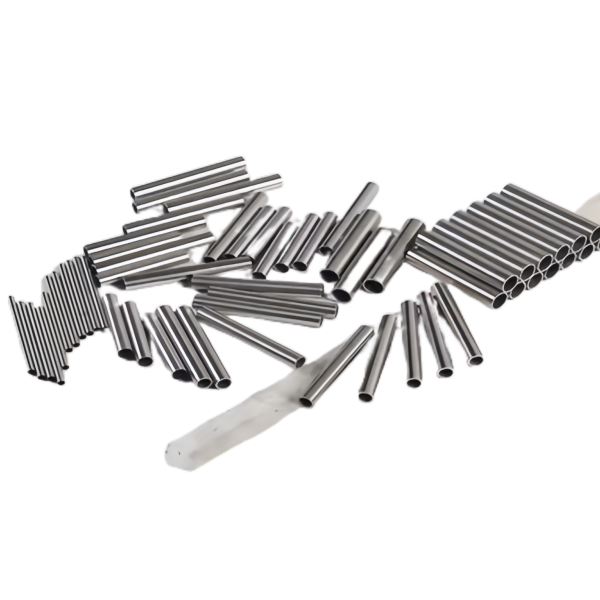
The Stainless Steel Capillary Tube Bundle for Sensor Probes is a set of fine stainless steel capillary tubes held together as one assembly, each tube carrying a sensor lead or a sensing element to its measurement point. A bundle is not just several loose tubes – it is a managed assembly where the tubes have to stay aligned, protected and individually identifiable along their whole length. The engineering of a bundle shifts from the individual tube, which is simple, to the relationships between the tubes: their spacing, their protection where they run together, and the fact that a sensor system is only as reliable as the tube that is pinched, kinked or mixed up. This page covers the bundle structure, the alignment and the protection the tubes need as a group.
A bundle is an assembly, and the tubes have to stay individually identifiable
In a sensing system each capillary tube goes to a specific measurement point, and if two tubes are swapped or a lead is misrouted, the system reads the wrong location even though every tube is perfect. The bundle therefore has to keep its tubes identifiable and in order along the whole length, which is a discipline of layout, marking and packing rather than of any single tube. A bundle that arrives with its order confused is a failed assembly regardless of tube quality.
- Tube order and identity are maintained through the bundle, with marking or a layout that survives handling and installation.
- Where the tubes differ, the difference is visible at the connections so a misroute is caught before the system is energised.
- Bundle layout is documented, so the installer knows which tube goes to which point without guessing.
Alignment and spacing: the tubes must not pinch or abrade each other
Tubes running together in a bundle rub, and fine capillary tubes rubbing against each other over a long run wear, kink or gall – especially stainless steel against stainless steel, which galls. The bundle therefore has to hold the tubes in a controlled spacing that keeps them from bearing on one another, while still keeping them compact enough to route. That is a structural design problem: the tubes need to be held apart and supported as a group without being squeezed together.
- Tubes are spaced so they do not bear on each other, because stainless steel capillary tubes that rub will gall and eventually fail.
- The bundle is supported along its length so its own weight and any bending do not kink the finest tubes.
- Where the bundle is flexed in service, the bend radius is controlled so the tubes on the outside of the bend are not stretched kinked.
Protecting the fine tubes where they are most vulnerable
The ends of the tubes, and any point where the bundle is handled, connected or routed through a tight space, are where capillary tubes get damaged. A fine stainless steel tube kinked at a connector or crushed where the bundle passes through a gland is a dead sensing channel. The bundle design therefore concentrates protection at the ends and at the stress points, using sleeving, strain relief or a protective sheath exactly where the tubes are exposed.
- Tube ends are protected at the connectors, because a kinked or crushed end is the most common way a capillary channel dies.
- Strain relief is provided where the bundle transitions from protected to exposed, so handling load does not reach the fine tubes.
- The bundle is routed and clamped so it is not crushed where it passes through a gland, a clamp or a tight bend.
Cleanliness and open ends: keeping the bores clear
Capillary tubes are fine-bored, and a bundle of them has many small bores that all have to arrive clear and clean, because a partially blocked bore is a slow or wrong reading. Bundles are also easy to contaminate during assembly, because the tubes are handled as a group and a burr, a swipe of lubricant or a particle can end up in a bore. Cleanliness is therefore a functional requirement on the whole bundle, verified per tube rather than assumed from a clean shop.
- Each bore is verified clear along its length, because a fine bore blocks easily and a blocked bore reads wrong.
- Assembly is controlled so lubricant, burrs and particles do not enter the open bores while the bundle is being built.
- Open ends are capped until installation, because an open fine bore in a shop collects debris within hours.
How we verify a capillary tube bundle
Verification on a bundle checks each tube individually and the bundle as an assembly, because the tubes and the way they are held together are separate requirements.
- Individual tubes: bore, outer diameter and length verified per tube against its drawing, with each bore confirmed clear along its length.
- Alignment and spacing: the bundle checked for controlled spacing that keeps the tubes from bearing on one another.
- Order and identity: the tube layout confirmed against the documentation, so each tube is identifiable at its connection.
- Protection: ends, strain relief and routing points inspected for the sleeving and support that keep the fine tubes undamaged.
- Cleanliness: bores verified clear and clean, with open ends capped until installation.
- Material certificates per lot for the tubes, traceable to the release, with a fit check at the connections before the bundle ships.
First articles and retention samples are kept for the programme, so a repeat bundle is built to the same verified tube set and layout. On an assembly whose value is many fine tubes staying clear, aligned and individually identifiable along their whole length, that baseline is what keeps a second bundle routing and reading exactly like the first.
You will find this part in our Sensor Housings range. Process notes, common materials and inspection points for every product in the family are collected across the sensor housings pages.
Specifications
| Item | Stainless Steel Capillary Tube Bundle for Sensor Probes |
|---|---|
| Brand | AUNOV |
| Designing | Send us your 2D drawing, or mail a probe sample for measurement, our engineers reply with a manufacturability assessment and pricing. |
| Tooling | Tooling designed and cut in house, held under your part number. |
| Samples | First-off samples are sent with dimensional data and material certs. |
| Materials | 304 / 316 stainless steel leads the stock list for this part, alongside carbon steel (SPCC / DC01), aluminium, brass and copper, per the drawing. |
| Surface finish | Finish options: plating, e-coat, powder coating, anodising or passivation, per the drawing. |
| Processing | Progressive deep draw stages with in-line annealing as the draw ratio demands, then pierced and CNC-machined in house. |
| Equipment | Mechanical presses 5-250 T and hydraulic presses 250-500 T, CNC turning and milling cells, a climate-controlled CMM room. |
| Tolerance | +/-0.1 mm as-drawn, +/-0.03 mm on machined surfaces. |
| Delivery terms | FOB standard, DDP offered for EU and US, payment T/T or L/C, D/P for repeat accounts, call-off schedules and blanket orders supported. |
Frequently Asked Questions
Why does a bundle need each tube individually identifiable?
Because each one carries something different. A bundle typically routes several leads or sensing channels side by side, and if they cannot be told apart at the termination, wiring errors become permanent rather than merely inconvenient. Identification is therefore a functional requirement of the assembly, not a labelling preference applied afterwards.
What actually happens if fine tubes touch each other?
Two failure routes, depending on how they meet. Continuous rubbing wears through a wall that has very little margin, and steady pressure closes a bore that has even less. Keeping them separated and spaced is therefore part of the product rather than part of the packing, and it belongs in the drawing.
Where are fine tubes most vulnerable?
At the ends and at the breakout, which is where everything happens to them. Ends have to be sealed or connected, and the point where individual tubes leave the bundle takes all the flexing. Protection there – sleeving, strain relief, controlled bend radius – delivers more than strengthening the tubes themselves.
Why is keeping the bores clear harder on a bundle than on one tube?
Because there is no second chance. One tube can be flushed and inspected individually; a bundle has several bores that have to be clean together and stay clean through bundling, handling and termination. One blocked line writes off the whole assembly, so cleanliness gets treated as part of building it rather than as a final rinse.
Related Products


Request a Quote for This Part
Send a drawing or sketch — get material advice, tooling cost and a per-piece price within 24 hours (working days).