
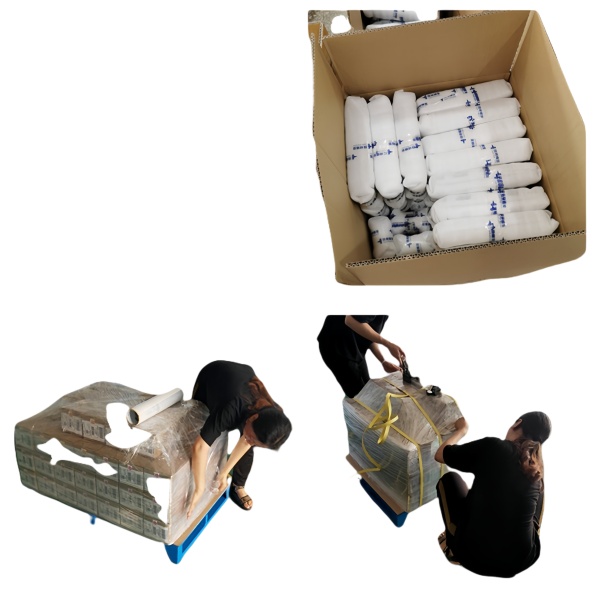
Packing is a process, and it starts at the drawing review
This part number exists because a customer somewhere received a machined component that had been made perfectly and then destroyed in transit. That happens more often than the industry admits. A CNC machined part is, by definition, a part whose value sits in its tolerances, its surface condition and its fits, and all three of those attributes are vulnerable to a box that was chosen for cost rather than for protection. We treat packing as a manufacturing operation with its own specification, its own inspection, and its own place in the process flow.
This page describes a mixed order of custom CNC machined parts prepared for shipment: carbon steel, 304 and 316 stainless steel, aluminium, brass and copper components, machined on CNC turning centres and mills to ±0.03 mm on machined features, then cleaned, protected, identified and packed against a documented method. The tolerance statement in our specification table distinguishes as-drawn features at ±0.1 mm from machined features at ±0.03 mm, which is a reminder that these parts may combine a formed blank with a machined interface. The packing has to protect both, and the two have different vulnerabilities.
The damage modes nobody lists in a purchase order
Transport damage to machined parts is not one phenomenon. It is at least six, and each one has a different countermeasure. Naming them explicitly is the only way to write a packing method that actually works.
| Damage mode | What it looks like on arrival | Countermeasure |
|---|---|---|
| Impact bruising | Local dents, flattened corners, deformed threads | Individual separation and a cushioning layer with a defined drop rating |
| Abrasion | Fine scratches on finished faces, polished areas dulled | Non-abrasive interleaves, no direct part-to-part contact |
| Corrosion in transit | Flash rust on carbon steel, white spots on aluminium, tarnish on brass | Vapour-phase inhibitor or oil film, desiccant, sealed barrier |
| Electrolytic couple | Corrosion only where two different metals touched | Physical separation of dissimilar metals |
| Distortion | Out-of-round thin-wall parts, bent shafts, warped plates | Support at the correct locations, not just at the ends |
| Loss of identity | Mixed parts, missing certification, no way to trace a lot | Bag-per-part-number with a label that survives the journey |
The fourth row is the one that catches people out. Put a stainless steel pin in contact with an aluminium plate in a humid container and you have built a galvanic cell. Nothing happens for two weeks; then there is a pit on the aluminium exactly where the pin rested. The fix costs nothing, which is why it is so annoying when it is missed.
Cleaning is a machining step, and it decides what the packing can be
You cannot protect a surface you have not first made clean. Machining leaves cutting fluid, metal fines, and for certain metals a residue of the coolant chemistry. Aluminium fines in particular are notorious: they embed in soft surfaces and later oxidize in place, producing grey or black staining that looks like corrosion but is actually the part eating its own swarf.
The cleaning route we apply depends on the material and on what follows:
- Carbon steel. Alkaline aqueous wash, dry, then an oil or rust-preventive film. The film choice depends on whether the customer will need to degrease before assembly, brazing or painting, and on how long the parts will sit in storage. A three-month protective oil and a twelve-month protective oil are different products.
- Stainless steel. Degrease and dry, with optional passivation if the part was machined with iron-contaminated tooling. Free iron on a stainless steel surface will rust and it looks exactly like the stainless steel itself has failed, which starts a quality dispute that is entirely avoidable.
- Aluminium. Mild alkaline clean with strict time control because aluminium is amphoteric and both strong acids and strong alkalis attack it. Dry thoroughly; trapped moisture in a blind tapped hole is a chronic problem on aluminium.
- Brass and copper. Degrease and apply a tarnish inhibitor if the cosmetic appearance matters, since copper alloys darken in humid air and the change is visible.
Blind holes, cross-drillings and tapped features deserve specific attention. A tapped blind hole can hold several microlitres of fluid that leaks out during transit and stains the surroundings, and no amount of external wrapping will prevent that. We blow out trapped features with filtered dry air and verify on a sample basis by examining the hole floor under magnification.
Matching the barrier to the journey, not to habit
The single most common packing failure in contract machining is applying the same wrapping to every shipment regardless of route. Sea freight to northern Europe in winter and air freight to a dry inland destination are not the same problem. The variables that determine the correct barrier are transport mode, transit duration, ambient humidity profile, and whether the container will pass through a condensation cycle.
- Domestic air or road, under a week, dry climate. Individual bags with a light oil film are sufficient. Vapour-phase inhibitor paper is optional.
- Sea freight, four to six weeks, humid route. Individual oiled or VCI-protected parts in sealed bags, desiccant sized to the internal volume of the barrier, then a rigid outer carton. The classic error is adding desiccant without sealing; unsealed desiccant saturates in a day and does nothing.
- Sea freight with a temperature swing, such as a container crossing the equator and then entering a cold port. This is the worst case, because the container’s interior air releases moisture onto cold metal surfaces. VCI emitters plus desiccant plus a sealed barrier, and the parts should be at ambient temperature at the moment of sealing, not warm from a wash line.
- Long-term storage after arrival. If the customer will store for a year, the protection belongs on the part and not only around it. A VCI film on the part survives opening the crate; desiccant in the crate does not.
Restraint, cushioning and the geometry of a mixed box
Cushioning and restraint are different functions and both are needed. Cushioning absorbs the energy of an impact; restraint stops the part from moving inside the box in the first place, which is what actually prevents abrasion. A box full of parts floating in loose foam is cushioned and unrestrained, and the parts will polish each other during vibration.
For this order, layered packing is used. Parts are separated by part number, each sub-lot wrapped or bagged, then placed in a layer with a defined orientation, with a divider or a foam sheet between layers, and the whole assembly blocked so it cannot shift. Shafts and thin-wall bushings are the critical items in this regard. A shaft supported only at its ends will develop a permanent set from its own weight during a long transit, particularly if it is hot or if the container is hot, because aluminium and brass both lose stiffness noticeably as temperature rises. Supporting a shaft at three points instead of two can be the difference between a usable part and a scrapped one.
For thin-wall parts, distortion is often not caused by external force at all. A bushing clamped in a soft foam cut-out that fits too tightly is under hoop stress the entire journey, and it will arrive slightly oval. The cut-out has to be a clearance fit to the part’s largest permissible diameter, not a nominal fit.
Labels, traceability and the paper that travels with metal
Inside the carton, every sub-lot carries a label stating part number, revision, quantity, lot or heat number, material certificate reference, and the customer’s purchase order line. That label should be readable after a week of handling and should survive condensation; laser-printed synthetic stock does, thermal paper does not. We include the label inside the bag when the bag is sealed, plus a duplicate on the outside, so that a bag opened in a receiving inspection can still be tied back to the lot.
The documentation set that ships with a machined order typically includes the dimensional inspection report for the sampled or gauged features, the material certificate with heat number traceability, the finishing certificate if a plating, anodizing or coating operation was performed, and the first-article report if this is a new part number. For parts with a safety function or a regulated application, the customer may additionally require a certificate of conformity and a full dimensional layout on every lot. Tell us at the quotation stage which documents the receiving inspection will demand, because generating a full layout retroactively means holding the parts longer and re-fixturing them, which is work nobody wants to schedule twice.
Incoming inspection and the first fifteen minutes
The receiving side has fifteen minutes to establish whether a shipment is intact, and a well-built package helps them do it. The sequence we design for is: visual inspection of the outer carton for crush or water damage, then check the humidity indicator card if one was included, then break the barrier and check for condensation on the parts, then count and identify by label, then inspect the first piece from each lot.
A humidity indicator card is a small addition that resolves a large argument. If the card shows the barrier stayed dry, then any corrosion found later is a part-quality issue, not a transit issue, and both parties can stop spending time on the wrong hypothesis. If the card shows saturation, the conversation becomes about packing, which is our responsibility and which we can fix on the next order.
What we need from you to pack correctly
- The transport mode and the destination, since these set the corrosion protection level.
- Any assumption about how long the parts will sit before use, either with you or with your customer.
- The downstream process: will the parts be degreased, welded, painted, or assembled as-received? A protective oil that fights a subsequent paint process is a defect, not a protection.
- Whether any surface is cosmetic or is a sealing face, which raises the standard for interleaving and handling.
- Any features that are dimensionally fragile — thin walls, long shafts, fine threads, sharp edges.
- The required documentation set and whether it must be enclosed in the carton, emailed ahead, or both.
- Any restriction on packing materials, for example whether the receiving country restricts certain wood packaging or foam types.
Standard packing is in the piece price; anything beyond it is a line item
Do you charge separately for packing?
Standard packing is included in the quoted piece price. Packing above the standard — for example a returnable steel rack, a custom thermoformed tray, or a nitrogen-purged barrier for a moisture-sensitive assembly — is quoted as a line item, because those materials do not scale with quantity in the same way the parts do.
Can you pack one part number per box instead of a mixed order?
Yes, and for high-value or cosmetic parts it is usually the better choice. Mixed boxes are efficient in volume but they multiply the number of contact interfaces, and every contact interface is a chance for a scratch.
What happens if parts arrive damaged?
Photograph the carton before opening, photograph the barrier and any humidity indicator, then photograph the parts as found. Retain the packaging. With that evidence the cause is usually diagnosable in a single conversation, and if the failure is ours we replace the affected parts.
Will you hold stock and ship against call-off schedules?
Yes. Call-off schedules are supported, and for a schedule we will agree the packing so that each release can be taken from storage and shipped without repacking. This is where the protection on the part, rather than around the crate, pays for itself.
Our CNC Machining Parts range is where this part sits. The cnc machining parts pages carry the process notes, common materials and inspection points behind every product in the family.
Specifications
| Item | Custom CNC Machined Parts Packed for Shipment |
|---|---|
| Brand | AUNOV |
| Designing | A drawing file or a physical sample starts the review, DFM feedback is returned with the quote. |
| Tooling | Tooling designed and cut in house, held and maintained under your part number. |
| Samples | First articles go out with a dimensional report plus material certs. |
| Materials | Held stock: carbon steel (SPCC / DC01), 304 / 316 stainless steel, aluminium, brass and copper, with grade selection confirmed at drawing review. |
| Surface finish | Zinc, nickel or chrome plating, e-coat, powder coat, anodising or passivation, per your print. |
| Processing | Deep drawing in stages, in-line annealing where needed, with piercing and finish machining under the same roof. |
| Equipment | 5-250 T mechanical presses plus 250-500 T hydraulic presses, CNC turning centres, climate-controlled CMM room. |
| Tolerance | +/-0.1 mm as-drawn, with machined features to +/-0.03 mm. |
| Delivery terms | Standard terms FOB, DDP offered to EU and US, T/T or L/C, D/P on repeat business, scheduled call-offs welcome. |
Related Products


Request a Quote for This Part
Send a drawing or sketch — get material advice, tooling cost and a per-piece price within 24 hours (working days).