
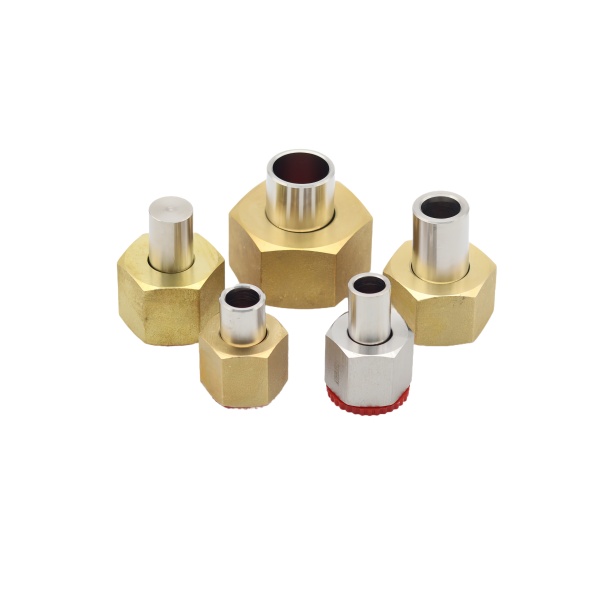
Brass hose fitting stem length and OD determine the flow restriction it introduces into the system
A brass hex hose fitting with an integral stem—a barb fitting, a welded nipple, or a swaged adapter—adds flow resistance to the hydraulic or fluid line it connects. The stem, being a smaller diameter than the hose ID, acts as a local flow restriction whose pressure drop is proportional to the stem length and inversely proportional to the fourth power of the stem diameter (per the Darcy-Weisbach equation for turbulent flow in small tubes).
For a typical 3/8″ hose ID (9.5 mm) fitting with a 6 mm OD × 30 mm long stem carrying SAE 10W-40 oil at 60 °C and 2 L/min flow rate, the pressure drop across the stem is roughly 0.02 MPa (3 PSI)—negligible for most systems. But if the same fitting carries 10 L/min (a larger system), the pressure drop rises to roughly 0.4 MPa (58 PSI)—significant enough to affect the system’s pressure balance calculation. We calculate the expected pressure drop for every new fitting design and include it in the technical data package so the customer’s system designer can account for it in the overall hydraulic model.
Brass material selection between C36000, C37700, and C2800 affects machinability more than corrosion resistance
Brass alloys for machined fittings fall into three categories based on lead content and intended application:
- C36000 (free-machining brass, 2.5–3.0 % Pb): The default choice for all brass fittings unless specified otherwise. Machines at 135 % of the speed of carbon steel with excellent chip formation and surface finish. Lead particles act as internal lubricants during cutting, reducing tool wear and allowing higher feed rates. Corrosion resistance is adequate for fuel, oil, air, and fresh water but marginal for seawater or ammonia (dezincification risk). Cost: lowest of the three due to high machining productivity.
- C37700 (leaded forging brass, 0.5–1.5 % Pb): Better hot workability than C36000 (designed for forging operations) but slightly lower machinability (~110 % of steel speed). Used when the fitting requires both machining and forming operations (e.g., a forged body with machined ports). Corrosion resistance similar to C36000.
- C2800 (Muntz metal, 60 Cu / 40 Zn, no lead): Selected specifically for seawater applications where dezincification of C36000/C37700 would cause rapid failure. No lead means machinability is lower (~80 % of steel speed) and tool wear is higher. Requires sharper tools, lower feeds, and more frequent tool changes. Cost: ~15–20 % higher than C36000 per part due to longer cycle time and shorter tool life. Used only when the drawing specifies “seawater resistant” or “naval brass” or when we have confirmed with the customer that the application involves saltwater exposure.
Hex size relative to the stem diameter determines whether the fitting can be torqued without damaging the stem
The hex body of a hose fitting provides the wrench interface for tightening. If the hex size is too small relative to the stem diameter (e.g., a 10 mm hex on a fitting with an 8 mm stem), the torque required to seal the fitting may exceed the torque that the hex can transmit without rounding—especially if the fitting is installed in a confined space where only a short-handled wrench or adjustable wrench can be used.
We follow the rule that the hex across-flats dimension must be at least 1.25× the stem outer diameter for standard-torque applications (torque ≤ 20 N·m for M6–M12 fittings) and at least 1.5× for high-torque applications (torque up to 50 N·m for fittings on heavy equipment). If the customer’s envelope limits the hex size below this ratio, we recommend adding a wrench flat (a milled flat on the body that provides additional wrench engagement area) or switching to a socket-wrench interface (a cylindrical body with a drive square) that can transmit higher torque in a smaller envelope.
The junction between the brass body and the stem is a potential failure point under vibration
When the stem is a separate piece joined to the brass body—by brazing, TIG welding, or mechanical press-fit—the junction must withstand cyclic loading from hose movement, pump vibration, and thermal expansion mismatch between the brass body (CTE ≈ 20 µm/m·K) and the stem material (steel CTE ≈ 12 µm/m·K if the stem is stainless steel, or brass CTE ≈ 20 µm/m·K if the stem is also brass).
If the stem is brass and brazed to the brass body using a BAg-8 silver braze (melting point ~780 °C), the joint strength at room temperature is typically 200–250 MPa shear—more than adequate for any hose fitting load. But at elevated temperatures (above 150 °C, possible near engines or in process equipment), the braze softens and the strength drops to 100–150 MPa. This is still sufficient for most applications, but if the fitting also sees axial vibration (from a reciprocating pump, for example), the fatigue strength of the braze joint at elevated temperature may become the limiting factor. We address this by designing the stem with a minimum overlap length of 1.5× the stem diameter inside the body, which distributes the cyclic shear stress over a larger braze area and extends fatigue life by 3–5× compared to minimum-overlap designs.
Surface treatment on brass fittings serves different purposes than on stainless steel or aluminum
Brass fittings can be shipped in several finish conditions, each serving a specific purpose:
- Bare/Passivated: The as-machined surface with a light passivation (dip in 5 % chromate solution for 30 seconds) to remove free copper and zinc oxides. Appearance: bright gold color typical of machined brass. Suitable for internal components and applications where appearance is not important. Lowest cost.
- Nickel plating: Electrolytic nickel (5–10 µm) over brass provides a hard, wear-resistant surface (500–700 HV) that looks like bright chrome/silver. Used for fittings where the external surface will be handled frequently (valve handles, manual shutoffs) or where a specific cosmetic appearance is required. Adds ~0.05 USD/cm² of surface area.
- Chrome plating: Decorative chrome (0.3 µm nickel undercoat + 0.3 µm chrome topcoat) provides the classic “bright hardware” appearance. Excellent corrosion resistance for indoor use but limited outdoor durability (micro-cracking in the chrome layer allows eventual base-metal corrosion). Used primarily for automotive and consumer-product fittings where appearance drives the purchase decision.
- Clear coating / Lacquer: A clear organic coating (acrylic or polyurethane, 25–50 µm) over bare brass prevents tarnishing (the gradual darkening of brass due to Zn oxide formation) while preserving the natural brass color. Used for architectural hardware and visible fittings where the warm tone of brass is desired but oxidation must be prevented. Requires re-coating every 5–10 years in outdoor service.
How we verify that a batch of brass hose fittings will seal reliably before shipping
Our final validation protocol for brass hose fittings with stems includes:
- Dimensional audit: All critical dimensions (stem OD and length, thread class and pitch diameter, hex size, body length, overall length) measured against the drawing. First article: 100 % of features. Production: SPC sampling (every 50th part) with go/no-go gauges for threads and hex, calipers for lengths and diameters.
- Material verification: Mill test report confirming alloy composition per ASTM B16 (C36000) or B453 (C37700). For C2800 orders, additional verification of lead content (< 0.05 %) by ICP-OES to confirm no accidental cross-contamination from C36000 stock.
- Pressure test (sample): One fitting per 200 parts (minimum 1 per batch) assembled with a master hose (SAE J1503 type matching the fitting’s barb size) and a constant-torque clamp. Pressurized to 1.5× rated working pressure for 60 seconds. Acceptance: zero leakage, zero hose slip-off, zero permanent deformation of the barb.
- Torque verification: One fitting per batch torqued to spec in a calibrated torque wrench fixture. Verification: the fitting does not round, crack, or deform at the specified torque. The torque value is recorded on the CoC so the customer knows what we tested to.
- Visual/cosmetic check: Every part inspected under standardized lighting for surface defects (scratches, dents, tool marks, plating flaws). Parts are graded A/B/C; only A and B grade ship unless the customer has explicitly accepted C-grade for non-visible applications.
This part belongs to our CNC Machining Parts range. The cnc machining parts pages collect the process notes, common materials and inspection points behind every product in the family.
Specifications
| Item | Brass CNC Machined Hex Hose Fittings with Stems |
|---|---|
| Brand | AUNOV |
| Designing | Send us your 2D drawing, or mail a fitting sample for measurement, the quotation comes back with a manufacturability review attached. |
| Tooling | Every die designed and built in our toolroom, stored under your part number. |
| Samples | Approval samples ship with a full dimensional report and material certification. |
| Materials | Brass is the primary stock for this part, alongside carbon steel (SPCC / DC01), 304 / 316 stainless steel, aluminium and copper, and the grade is fixed at the drawing review. |
| Surface finish | Plating, e-coat, powder coating, anodising or passivation as the drawing calls out, fixed at the drawing review. |
| Processing | Multi-stage drawing, annealed in line where wall thinning calls for it, then pierced and CNC-machined in house. |
| Equipment | Press capacity from 5 to 500 T across mechanical and hydraulic lines, CNC turning centres, climate-controlled CMM room. |
| Tolerance | Tolerances to +/-0.1 mm as drawn, +/-0.03 mm on machined features. |
| Delivery terms | FOB as standard, DDP available for EU and US destinations, T/T or L/C, with D/P for repeat business, call-off schedules supported. |
Related Products


Request a Quote for This Part
Send a drawing or sketch — get material advice, tooling cost and a per-piece price within 24 hours (working days).