
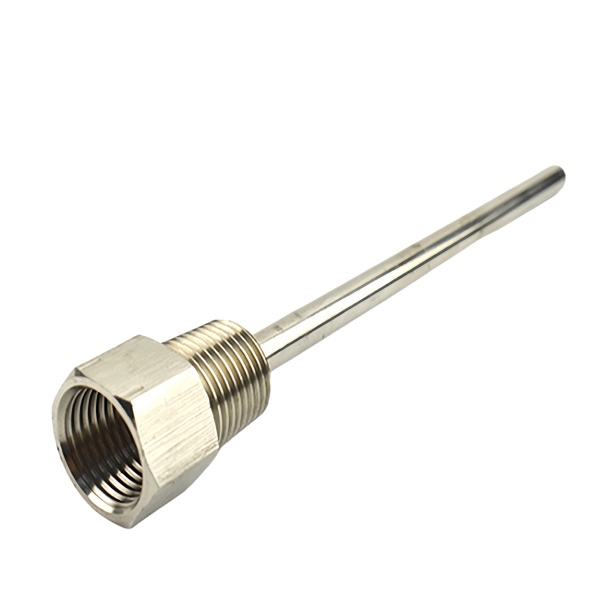
This brass thermowell is defined by its two ends: a long stem that puts the sensing tip out into the process, and a hex fitting at the top that is the whole interface between the instrument and the plant. The stem decides what the probe reads; the hex decides whether it can be installed and removed at all. Both have to be designed together, because a fitting that measures well but rounds off under a spanner is a fitting that gets replaced with a damaged port behind it.
Stem length is chosen for immersion, and immersion is a response decision
The stem on a thermowell is not a standoff – it is what positions the tip in the stream instead of in the still boundary layer against the pipe wall. Too short and the reading is a weighted mix of process and ambient that drifts with whatever the weather is doing outside the pipe. Specify the length from the depth of the flowing medium, and the response time follows from it.
The hex is the part the installer actually touches
Every assembly and removal load goes through the hex, and every one of them is applied by a person with a spanner in a space that was designed for something else. That makes across-flats and hex height functional dimensions, not cosmetic ones. A hex that is too shallow rounds before the joint has sealed; one that is too tall will not fit the boss or the nearby pipework. We size it to the tooling that will actually be used on it.
Across-flats, thread and seat are specified together
The three features share the same piece of metal and the same load path, so they cannot be specified independently. A strong hex with a thread that galls is a fitting that seizes in the boss; a clean thread with a soft hex is one that cannot be undone next service. Brass helps here because it seals at modest torque and resists galling against the boss, and we keep the thread form and the seat geometry matched to that behaviour rather than copying a steel fitting’s specification.
Keeping a long brass stem true
A long slender stem is the easiest thing on this part to ruin after it is finished. Brass is softer than stainless steel, so it takes a set from handling, stacking or a loose fixture more readily. Straightness over the full stem is held by supporting the part through machining, cleaning and packing, and it is checked along the length rather than only at the ends.
How a long-stem hex fitting is checked before it ships
The stem, the hex and the straightness between them are inspected as one assembly, because a probe that is correct at both ends and bent in the middle still reads the wrong position.
First articles and retention samples are kept for the programme, so a reorder reproduces the same stem, the same across-flats and the same straightness. On a fitting whose job is to be installed and later removed, that is what keeps the second batch serviceable.
Parts like this one sit under the Sensor Housings range, whose overview page gathers the tooling logic, finishing options and tolerance notes shared across the family.
Where this part is used
Long-stem hex-fitting thermowells screw into a port and put the sensing tip out into the process, which makes them the standard protection for temperature measurement in piping, vessels and ducts. We see them in process plants, in HVAC and boiler circuits, and in water treatment where the thermowell has to be removable without draining the line.
The hex is the part the installer actually touches, and it is the whole interface between the instrument and the plant. A thermowell that is correct at the sensing end and awkward at the hex end still fails, because it is installed by hand with a spanner in a tight space.
What we need to quote it
Send the immersion length together with the process temperature, since those two decide the stem material and the wall. Add the port thread standard and the hex across-flats, and tell us whether the thermowell is screwed or flanged in your assembly. If the stem has to be replaceable under pressure, say so — that changes the thread form we quote.
Specifications
| Item | Brass Thermowell with Long Stem Hex Fitting |
|---|---|
| Brand | AUNOV |
| Designing | Share your print, or send a part to be measured, a manufacturability review comes back with the quotation. |
| Tooling | Dies designed and built in our own toolroom, stored under your part number. |
| Samples | First-article samples of the fitting ship with dimensional data plus material certs. |
| Materials | Brass is the primary stock for this part, alongside carbon steel (SPCC / DC01), 304 / 316 stainless steel, aluminium and copper, with the final grade confirmed at the drawing review. |
| Surface finish | Plating, e-coat, powder coating, anodising or passivation, fixed at the drawing review. |
| Processing | Staged deep drawing with in-line annealing where needed, then pierced and CNC-machined in house. |
| Equipment | Mechanical presses 5-250 T and hydraulic presses 250-500 T, CNC cells plus a temperature-controlled CMM room. |
| Tolerance | +/-0.1 mm on as-drawn surfaces and +/-0.03 mm on machined surfaces. |
| Delivery terms | FOB is standard; DDP offered for EU and US, T/T and L/C accepted, D/P for established customers, call-off schedules supported. |
Related Products


Frequently Asked Questions
Why is stem length an immersion and response decision?
The stem on a thermowell is not a standoff, it is what positions the tip in the stream instead of in the still boundary layer against the pipe wall. A long stem puts the sensing tip out into the process where the reading is meaningful. Stem length is therefore chosen for immersion, and immersion is a response decision.
Why must the hex and the thread be specified together?
A strong hex with a thread that galls is a fitting that seizes in the boss, while a clean thread with a soft hex is one that cannot be undone at the next service. The across-flats, the thread and the seat have to be specified together for that reason. Both have to be designed as one, because a fitting that measures well but rounds off under a spanner gets replaced with a damaged port behind it.
Why brass rather than steel for this long-stem fitting?
Brass helps here because it seals at modest torque and resists galling against the boss, so we keep the thread form and seat geometry matched to that behaviour rather than copying a steel fitting’s specification. It is softer than stainless steel, so it takes a set from handling, stacking or a loose fixture more readily. Keeping a long brass stem true is part of the process plan.
What does a long-stem hex thermowell need at enquiry?
Add the port thread standard and the hex across-flats, and say whether the thermowell is screwed or flanged into the assembly. If the stem has to be replaceable under pressure, say so, because that changes the thread form we quote. Long-stem hex thermowells screw into a port and put the tip into the process, the standard protection for temperature measurement in piping, vessels, HVAC and boiler circuits.
Request a Quote for This Part
Send a drawing or sketch — get material advice, tooling cost and a per-piece price within 24 hours (working days).