
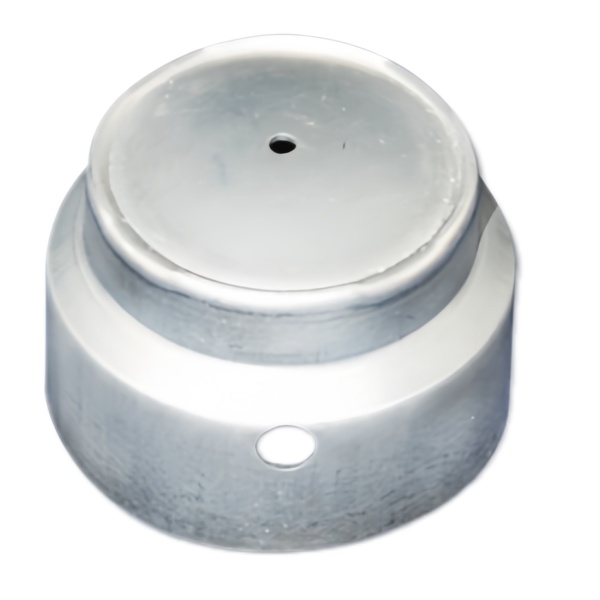
A stepped cover is two diameters, and the step is a stress line
A stepped cover is one drawn shell with two diameters joined by a shoulder, and the shoulder is the feature that decides whether the part runs or fights you. The step is a stress line: the material has to flow from the large diameter into the small one around a tight shoulder radius, and that radius is where the wall thins and where the cover either draws clean or tears. We treat the step as the primary engineering feature, not as the place two dimensions happen to meet, because everything about the cover’s fit flows from how that shoulder is formed.
The two diameters mean the cover has to index on both: the large diameter usually seats the rim and the small diameter enters the mating body, and the step height sets how deep the small diameter goes before the shoulder lands. We hold each diameter to its own tolerance regime, the rim as drawn at +/-0.1 mm and any machined feature on the step at +/-0.03 mm, and we dimension the step height as a controlled characteristic because it is the one that positions the cover in the assembly, not the small-diameter fit.
The shoulder radius is the lever. Too tight and the wall splits at the step on the first deep draw; too open and the step is not a step, it is a cone, and the cover loses the shoulder it was meant to land on. We start the shoulder radius at 2 to 3 times the wall thickness and tune from the first article section.
Drawing the step without a wrinkle in the shoulder
The shoulder is also where the cover wrinkles if the blank holder is wrong. As the small diameter is pulled through, the material around the shoulder is compressed, and if the hold-down is too light the shoulder buckles into a wrinkle that no amount of trimming removes, because it is formed into the wall, not lying in the flange. We set the blank holder force high enough to suppress the shoulder wrinkle but not so high that the wall stretches and tears at the shoulder radius, and we record that window against the part number at first article.
For a deep step the single draw may not be enough, and we stage it: a first draw to an intermediate shoulder, then a redraw that sets the final step, with in-line annealing where the wall has work-hardened. The staged approach keeps the shoulder crisp because each draw only does part of the reduction, so the local strain at the shoulder stays inside the material’s budget. A cover drawn to the step in one hit on a tight radius is a cover that wrinkles or splits depending on the day the press feels like.
We also watch the earing at the shoulder. Rolled sheet draws with a four-lobe pattern, and on a stepped cover that pattern shows as an uneven shoulder height, which we trim and check at four positions so a stepped cover that is taller on two sides is caught before machining the step.
The side hole is a piercing callout, and its position is a stack from the step
The side hole on a stepped cover is a piercing feature, and its position is not a free callout, it is a stack. The hole position runs from the step datum, because the step is the feature the assembly references, and any error in the step height or the shell roundness adds to the hole position before the pierce even happens. We therefore locate the shell for the pierce from the step, measure the hole as position to that datum, and report the stack, because the customer’s mating part cares about where the hole is relative to the step, not about where it is relative to the rim.
Piercing a hole in a stepped, curved wall needs support behind it, or the wall dishes toward the axis at the hole and the hole ovals. We support the bore for the pierce and deburr both sides, because on a cover the hole often carries a fitting or a vent and a burr there is a leak or a clearance problem. The hole is pierced after the shell is final, never before the last draw, because a pre-pierced hole migrates as the wall moves and lands where the metal went, not where the drawing put it.
For holes near the step we keep the pierce clear of the shoulder radius, because piercing into a radiused transition gives an out-of-round hole that no reamer will fully fix.
- Locate the pierce from the step datum and report hole position as a stack.
- Support the wall behind the pierce so the hole stays round and the wall does not dish.
- Deburr both sides; a burr on a cover hole is a leak or a clearance fault.
- Pierce after the shell is final so the hole does not migrate with the wall.
Step height controls the stack into the mating body, not the cover fit
The dimension that actually positions a stepped cover in its assembly is the step height, the distance from the rim face to the shoulder, because that is what stops the cover at the right depth before the small diameter bottoms out. The small-diameter fit is secondary; if the step height is wrong the cover seats too deep or too shallow and the small diameter either bottoms or stands proud, regardless of how well the diameter itself is held.
We therefore hold step height to a tight band, typically +/-0.05 to 0.1 mm, and we machine or restrike the step to hit it rather than leaving it to the draw, because a drawn step height carries the draw’s full variation. Where the cover must index precisely, we machine the shoulder face so the height is a machined feature at +/-0.03 mm, and the small diameter is then allowed to float within its drawn band, because the height, not the diameter, is doing the locating.
This is the inversion novices get wrong: they tighten the small diameter and leave the step to the draw, and the cover fits the bore perfectly while sitting a millimetre too deep. We tighten the step and let the bore breathe, because the step is the stop.
A cover seals on its rim, so the step must not let the rim go out of plane
A cover’s job is to seal, and it seals on its rim, so rim flatness is the tolerance that matters more than any diameter. The hazard unique to a stepped cover is that forming the step can pull the rim out of plane, because the shoulder draws material asymmetrically and the rim, being the free end, distorts with it. A rim that is out of plane by 0.2 mm will not seal evenly, and the assembly compensates by over-torquing the fasteners, which then load the step and the shoulder.
We hold rim flatness to 0.15 to 0.2 mm total and we win it at the trim and restrike, trimming the rim concentric to the axis and restriking it flat where the seal demands. A rim trimmed off a warped locator reads flat in the middle and curls at the ends, the classic stepped-cover defect, and it is corrected at the locator. Where the cover clips rather than seals, we still hold the rim straight enough that the clip engages along its length.
The step and the rim are therefore checked together on the first article: step height for position, rim flatness for seal, because a cover that indexes right but does not seal is a cover that fails in the field, not on the bench.
How we verify a stepped cover that has to index on two diameters
A stepped cover is verified on both diameters and on the step that joins them. The first article carries the checks below and production is audited against it.
- Step height is measured from the rim face to the shoulder and held to the locating band, machined where the index is critical.
- Rim flatness is checked on the surface plate and felt at four positions for the seal.
- Small and large diameters are gauged to their own regimes, drawn and machined as the drawing splits them.
- Side hole position is checked as a stack from the step datum, with the hole roundness verified.
- Shoulder wall thickness is sectioned on the first article and the minimum recorded.
- Material and heat are traced to the mill certificate so the shipment documents the steel drawn.
Send the drawing or a sample cover, and the review returns the shoulder radius, the step-height regime, and the hole position stack, so the cover that ships indexes on both diameters and seals on the rim.
Sizing the draw for a part like this — reduction per station, ironing allowance, flange width — is covered step by step in our deep drawn covers guide.
Specifications
| Item | Steel Deep Drawn Stepped Cover with Side Hole |
|---|---|
| Brand | AUNOV |
| Designing | Share your print, or send a part to be measured, a manufacturability review comes back with the quotation. |
| Tooling | Dies designed and built in our own toolroom, with your part number on the tool record. |
| Samples | Sample parts arrive with a dimensional report plus material certs. |
| Materials | Stock for this part leads with carbon steel (SPCC / DC01), alongside 304 / 316 stainless steel, aluminium, brass and copper, with grade selection confirmed at drawing review. |
| Surface finish | The drawing requirement picks between zinc, nickel or chrome plating, e-coat, powder coat, anodising and passivation. |
| Processing | Multi-stage drawing, annealed in line where wall thinning calls for it, then pierced and CNC-machined in house. |
| Equipment | Mechanical presses 5-250 T and hydraulic presses 250-500 T, CNC turning centres, climate-controlled CMM room. |
| Tolerance | +/-0.1 mm as-drawn, with machined features to +/-0.03 mm. |
| Delivery terms | Standard terms FOB, DDP offered to EU and US, T/T and L/C accepted, D/P for established customers, call-off schedules supported. |
Frequently Asked Questions
Why is the shoulder treated as the main feature rather than the two diameters?
The step is a stress line. Material has to flow from the large diameter into the small one around a tight shoulder radius, and that radius is where the wall thins and where the cover either draws clean or tears, so the fit of the whole part follows from how the shoulder forms.
Why is step height a controlled characteristic?
Because it positions the cover in the assembly. Step height sets how deep the small diameter goes before the shoulder lands, so it is not the same thing as the small-diameter fit and deserves its own callout.
Do both diameters carry the same tolerance?
No, each gets its own regime. The rim is held as drawn at +/-0.1 mm while any machined feature on the step is held at +/-0.03 mm, because indexing happens on both and they are not produced to the same capability.
Why is the side hole dimensioned from the step?
Its position is a stack from the step rather than a free-standing callout, since the step is what locates the cover. Dimensioning it independently lets it drift relative to the feature that actually positions the part.
Related Products


Request a Quote for This Part
Send a drawing or sketch — get material advice, tooling cost and a per-piece price within 24 hours (working days).