
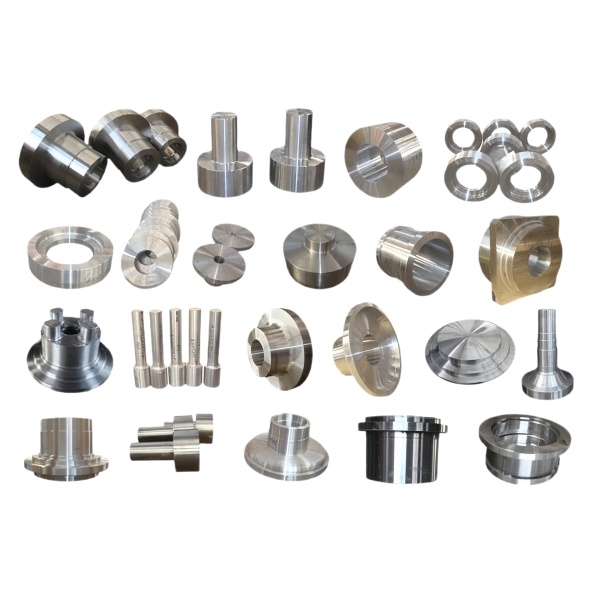
Gears and fittings in one stainless steel order share a shop but not a process discipline
An assorted order of stainless steel fittings and gears—threaded fittings in one section of the kit, machined gears in another—presents two different manufacturing disciplines under one material family. The fittings live and die by thread quality and seal geometry; the gears live and die by tooth geometry and concentricity. Treating them as “stainless steel parts” and running them through a generic process loses both disciplines at once.
We split the lot at the routing level: fitting part numbers route through turning cells with thread gauging at the machine; gear part numbers route through hobbing/shaping cells with first-article tooth inspection (measurement over pins, flank contact against a master gear) and heat-treat routing where the drawing calls for hardened teeth. The consolidation happens only at kitting—both disciplines’ outputs meet in the bag, verified and certified separately.
Stainless Steel gear hobbing: work-hardening is the tool-wear villain
Hobbing austenitic stainless steel (304/316) differs from hobbing carbon steel in one dominant way: austenitic stainless steel work-hardens under the cutter’s deformation zone, so each tooth’s finished surface is harder than the parent material, and the hob’s cutting edge wears against hardened surfaces all shift long. A hob that cuts 5,000 teeth in 4140 steel may manage 1,500–2,000 in 316 before the finish deteriorates past spec.
Our process controls: sharp hobs changed on a tooth-count schedule rather than on visible deterioration (dull hobbing in stainless steel generates a hardened smear layer on the flank that no amount of finishing recovers), flood coolant with good flank access, and hob speed kept in the range where work-hardening ahead of the cut is minimized. Tooth finish is checked at fixed intervals (comparator on one tooth’s profile per interval), because finish deterioration is the first symptom of a hob passing its life in this material.
When a gear needs 17-4 PH instead of austenitic: the torque-and-life calculation
Austenitic stainless steel gears (304/316) carry limited tooth-loading: yield strengths around 205–240 MPa put the allowable bending stress at 40–60 MPa with typical gear safety factors, which is fine for instrument and light-duty gears. When the gear transmits real torque (power transmission above roughly 0.5 kW per module-2 gear, or any shock loading), we move to 17-4 PH:
- 17-4 PH in condition A (annealed): Machines and hobs nearly as well as austenitic, then ages (H900: 480 °C, 1 hour) to HRC 40+ with a dimensional shrinkage of 0.04–0.06 % (we pre-compensate the hob’s setting depth).
- Allowable tooth stress: roughly 3–4× austenitic in the aged condition, with correspondingly longer fatigue life at austenitic load levels.
- The trade: H900 17-4 is less corrosion-resistant than 316 in chloride service (no molybdenum), so marine gear applications specify H1025 or accept 316’s lower load rating.
Kit-level verification: each discipline ships with its own certificate section
For the mixed fittings-and-gears kit, the documentation splits by discipline because the customer’s receiving inspection will too:
- Fittings section: Thread gauging certificates (standard, class, and gauge IDs used), seal geometry first-article report, pressure test data where rated, and material certs per alloy.
- Gears section: First-article tooth geometry (measurement over pins, helix/profile deviation where the drawing specifies AGMA/DIN quality grade), concentricity to bore (0.02 mm TIR typical), hardness per heat-treat lot, and a master-gear mesh report (backlash, contact pattern) for each gear part number.
- Combined kit: Consolidated packing list mapping every bag to its PO line and certificate section; photo reference sheet; segregation rules stated (plated parts, bare parts, gear faces protected from fitting threads).
The kit’s bags are packed so gear teeth never contact fitting threads: gears in individual wrapped pockets, fittings in their own bags. A fitting thread dragged across a gear tooth flank in transit is invisible at receiving and a noise source for the customer’s assembly from day one.
Our CNC Machining Parts range is where this part sits. The cnc machining parts pages carry the process notes, common materials and inspection points behind every product in the family.
Why fittings and gears share one stainless steel order
An assortment that pairs CNC machined fittings with hobbed stainless steel gears looks mismatched until you see the shop: both run on the same bar stock, the same coolant, and often the same pallet, so combining them drops setup and handling rather than adding complexity. The saving is real only if the routing keeps the two disciplines apart where it matters, gear hobbing generating swarf that the fitting bores must never see. We schedule the gear work to clear before the fitting finish cuts, or run them in separate cells, so the kit ships clean. The buyer gets one PO, one lot record, and one receiving inspection instead of two.
Mixed-part fixturing on one pallet
Holding a fitting and a gear on the same pallet means designing fixtures that locate each by its own feature, the fitting by its hex or thread and the gear by its bore, without either dictating the other’s position. We build the pallet so both part types index true and the post-process probe checks each against its own datum. This is the difference between a genuine kitting saving and a pallet that compromises one part to suit the other, and it is planned at the quoting stage, not discovered on the floor.
Specifications
| Item | Assorted Stainless Steel CNC Machined Fittings and Gears |
|---|---|
| Brand | AUNOV |
| Designing | Send drawings, or send a sample to be measured, you get a DFM review together with the quotation. |
| Tooling | Our own toolroom designs and builds every die, with your part number on the tool record. |
| Samples | Approval samples ship with a dimensional report plus material certs. |
| Materials | Stock for this part leads with 304 / 316 stainless steel, alongside carbon steel (SPCC / DC01), aluminium, brass and copper, and the grade is fixed at the drawing review. |
| Surface finish | Surface treatment per the drawing: plating, e-coat, powder coating, anodising, passivation, selected against the drawing requirement. |
| Processing | Multi-stage drawing, annealed in line where wall thinning calls for it, pierced and finish-machined on the same floor. |
| Equipment | 5-250 T mechanical presses plus 250-500 T hydraulic presses, CNC cells plus a temperature-controlled CMM room. |
| Tolerance | As-drawn tolerance +/-0.1 mm, +/-0.03 mm on machined surfaces. |
| Delivery terms | FOB as standard, DDP available for EU and US destinations, T/T and L/C; D/P on repeat accounts, call-off schedules and blanket orders supported. |
Related Products


Request a Quote for This Part
Send a drawing or sketch — get material advice, tooling cost and a per-piece price within 24 hours (working days).