
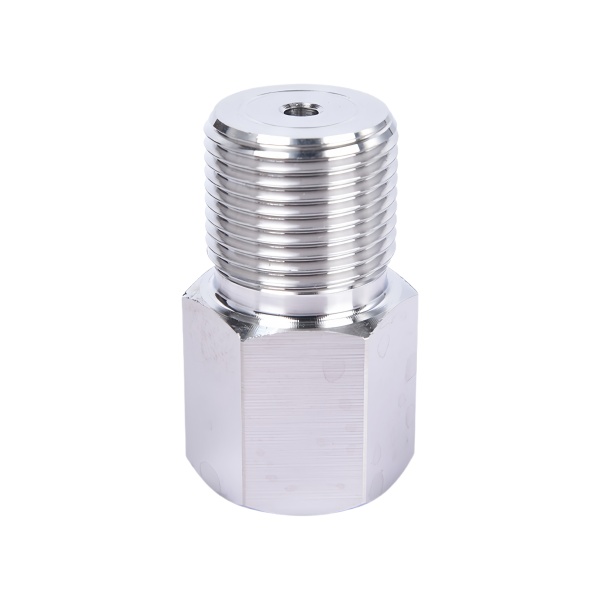
Hex-to-thread concentricity determines whether the adapter aligns or cocks when torqued
A hex threaded adapter—a fitting with a hex drive section between two threaded ends—relies on the hex for wrench torque during installation. If the hex is eccentric to the thread axis, the wrench applies force at a varying radius as the adapter rotates, and in soft housings the eccentric hex can also cock the adapter slightly as it beds against its seat.
We machine hex adapters in a single turning setup: the blank (hex bar for small sizes, or round bar with the hex milled) is gripped in a hex collet that registers on the hex flats, and both threads plus the sealing shoulder are cut without re-chucking. This holds thread-to-hex concentricity at 0.02 mm TIR. For adapters machined from round bar with a milled hex, the hex is milled first, then the part is transferred to a hex collet for threading—the collet registration guarantees that the threads grow from the hex’s own center rather than from an arbitrary lathe center.
Torque capacity of the hex section must exceed the thread’s installation torque with margin
The hex drive must transmit the full installation torque without rounding its corners. Corner rounding happens when the wrench contact stress exceeds the material’s yield strength at the hex corners, where contact area is smallest.
For stainless steel adapters (which gall and seize more than carbon steel, often requiring removal torque above installation torque), we size the hex so its torsional capacity is at least 2× the expected assembly torque. A practical check: an M12 adapter (installation torque ~35 N·m) needs a hex across-flats of at least 17 mm in 316 stainless steel (corner bearing area, for a hand-tightened-then-wrenched joint). Using a smaller hex—say 14 mm, to fit a compact envelope—drops the margin to about 1.2×, which survives careful assembly but rounds on removal after the thread has been in service and galled. When the drawing specifies an undersized hex, we flag the removal-torque risk on the quotation rather than discovering it in the field.
Dual-thread adapters with different pitches need full-thread engagement calculated for the weaker side
Many hex adapters are reducing or adapting fittings: a male thread on one end, a female thread on the other, possibly different standards (NPT to BSPP, M to UNF). Each side needs its own engagement-length calculation based on the weaker material pair in its joint.
The side that usually loses is the female thread: it taps into the adapter’s own wall, and the adapter wall is thinner than a typical boss. We calculate the female thread’s strip length as L = F / (π d τ K), where F is the axial load from the male fitting’s installation torque. For an M14 × 1.5 female thread in a 316 adapter with 4 mm wall under the thread, carrying a 4000 N axial load from the mating fitting at 40 N·m, the required engagement is about 6.5 mm. We tap to a minimum depth of 1.1 × nominal diameter (15.4 mm for M14) to leave margin for thread damage in service and re-tapping during maintenance.
Sealing surface condition between the two threads determines which seal method survives assembly
A hex adapter seals on at least one side—by thread sealant, a machined 30°/ 37° cone seat, an O-ring boss under the hex, or a flat gasket face. The sealing surface must survive the installation rotation without scoring.
For cone seats (JIC/ ORFS style), we machine the cone with a single-point tool, then finish with a fine boring pass to Ra ≤ 0.8 µm. A rough cone (Ra > 1.6 µm) will seal on first assembly but the asperities crush under service vibration and leak within days. For O-ring boss seals, the O-ring gland is machined with a sharp corner break (0.1 mm × 45°) at the gland’s outer edge—an unbeveled edge cuts the O-ring during assembly, and a cut O-ring is a warranty return waiting to happen. We verify gland edges at 10× magnification on every 25th part.
How we verify hex threaded adapters before shipping
Inspection protocol:
- Threads: Go/no-go gauges (both ends) on 100 % of parts. Class per drawing (2A/2B or 6g/6H standard; 3A/3B on request).
- Hex size: Go/no-go across flats; width across corners checked with calipers on sample (every 20th) to confirm no undersize hex.
- Concentricity: Part in V-blocks on the thread pitch diameter (using thread rolls or between centers on a threaded arbor); indicator on the hex and on the opposite thread’s seat. Acceptance: ≤ 0.02 mm TIR.
- Seal surfaces: Cone seats checked with blue against a master cone (contact band ≥ 70 % of seat width, centered). Flat gasket faces: flatness ≤ 0.01 mm on granite, Ra ≤ 1.6 µm. O-ring glands: edge condition at 10×, groove dimensions on first article.
- Pressure test (if rated): One adapter per batch assembled into a test port at installation torque, pressurized to 1.5× rated pressure for 5 minutes. Acceptance: zero leakage at either end.
- Galling check: One adapter per batch fully assembled and disassembled with its mating part. Threads inspected at 10× for pickup or galling marks. Stainless Steel adapters ship with a dry-film lubricant or anti-seize recommendation note unless the customer specifies clean/dry.
Parts like this one sit under the CNC Machining Parts range, whose overview page gathers the tooling logic, finishing options and tolerance notes shared across the family.
Specifications
| Item | Stainless Steel CNC Machined Hex Threaded Adapter |
|---|---|
| Brand | AUNOV |
| Designing | A drawing file or a physical sample starts the review, our engineers reply with a manufacturability assessment and pricing. |
| Tooling | Tooling designed and cut in house, held under your part number. |
| Samples | The first-article set ships with a dimensional report plus material certs. |
| Materials | 304 / 316 stainless steel leads the stock list for this part, alongside carbon steel (SPCC / DC01), aluminium, brass and copper, per the drawing. |
| Surface finish | Zinc, nickel or chrome plating, e-coat, powder coat, anodising or passivation, selected against the drawing requirement. |
| Processing | Staged deep drawing with in-line annealing where needed, with piercing and finish machining under the same roof. |
| Equipment | Our press floor runs 5-250 T mechanical and 250-500 T hydraulic presses, CNC turning centres and a climate-controlled CMM room. |
| Tolerance | As-drawn tolerance +/-0.1 mm, machined features held to +/-0.03 mm. |
| Delivery terms | FOB standard, DDP offered for EU and US, payment T/T or L/C, D/P for repeat accounts, call-off schedules supported. |
Related Products


Request a Quote for This Part
Send a drawing or sketch — get material advice, tooling cost and a per-piece price within 24 hours (working days).