
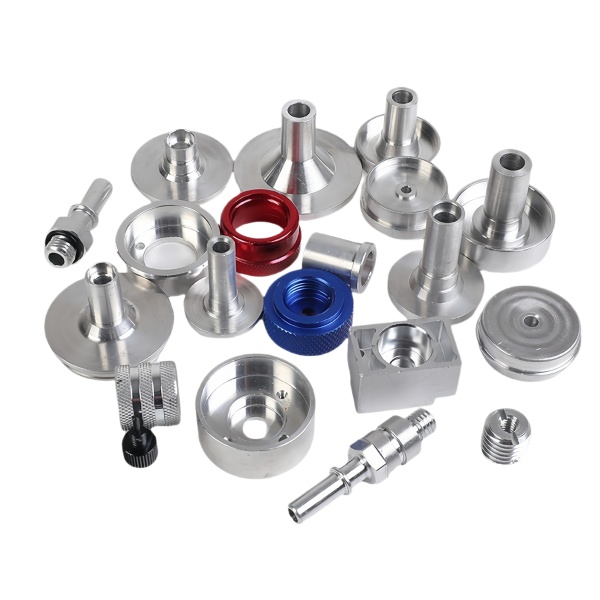
Accent ring anodize color contrast is controlled by the base anodize layer, not by the ring material
An aluminum body with anodized accent rings—common on consumer electronics enclosures, instrument panels, and automotive interior trim—achieves its visual appeal through the color contrast between the base body (usually natural or black anodize) and the accent rings (often red, blue, or gold anodize). The key to consistent contrast is not the dye color itself (which is relatively easy to control) but the underlying anodize layer thickness, because thicker layers absorb more dye and appear darker and more saturated than thinner layers at the same dye concentration and immersion time.
We produce two-tone anodized parts using a masking process: the body is first anodized to the base color (e.g., natural at 12 µm), then masked with photoresist or silicone, and the exposed ring areas are re-anodized to a different thickness (e.g., 15 µm for deeper red) before dyeing. The critical control point is ensuring that the mask edge is sharp (no bleed-under of < 0.2 mm) so that the color boundary is crisp. We use laser-cut polyimide film masks for production runs (positional accuracy ±0.05 mm) and hand-applied silicone masks for prototypes and small batches.
The transition between the body and the ring is a stress concentrator under thermal cycling
Where the anodize layer changes thickness—at the boundary between the body and the accent ring—there is a step in the oxide layer that creates a minor stress concentration in the aluminum substrate. Under thermal cycling (the part heats up and cools down during operation or during environmental exposure), this step experiences differential thermal strain because the thick oxide and thin oxide have slightly different coefficients of thermal expansion relative to the aluminum base.
In practice, this stress concentration is too small to cause cracking in 6061-T6 aluminum under normal service conditions (the strain difference is on the order of 10⁻⁶ per °C of temperature change). However, if the part is also mechanically loaded (a housing that carries structural loads, for example), the combined stress from mechanical loading plus thermal cycling can initiate a fatigue crack at the color boundary after 10⁵–10⁶ cycles. We mitigate this by adding a 0.2 mm wide “transition zone” at the mask boundary where the anodize thickness ramps gradually from the body value to the ring value over a distance of 0.5–1.0 mm, rather than an abrupt step. This gradient zone distributes the thermal strain over a larger area and reduces the local stress concentration by roughly 40 %.
Body wall thickness behind the accent ring must be sufficient for the anodize current density
During anodizing, the current density (amperes per square meter of surface area) determines the rate of oxide growth. If the aluminum body has non-uniform wall thickness—thicker in some areas, thinner near the accent rings—the current density will vary: thinner sections carry higher current density (less material → higher current per unit area) and grow oxide faster than thicker sections. This produces a non-uniform anodize layer that appears as a visible shade variation even before dyeing.
We design the body wall thickness to be uniform within ±0.1 mm across the entire part, including the areas behind the accent rings. Where the drawing requires a local thin section (for weight reduction or clearance), we add internal ribs that maintain a uniform external appearance while allowing the wall to vary internally. The goal is current density variation below 5 % across the entire anodized surface, which corresponds to a visual color variation below ΔE = 1.0—imperceptible to most observers under normal lighting.
Machining marks visible through the anodize layer are prevented by controlling the pre-anodize surface texture
One of the most common cosmetic defects on anodized aluminum parts is the visibility of machining marks—feed lines from the milling cutter, stop marks where the tool paused, and tool chatter patterns—showing through the anodize layer as light and dark bands parallel to the tool path direction. These marks are not removed by anodizing; in fact, anodizing can make them more visible because the oxide layer follows the underlying surface topography, and the dye accumulates slightly differently in the valleys versus the peaks of the machined texture.
We prevent visible machining marks through a combination of process controls:
- Use wiper inserts for all cosmetic-facing finishing passes. A wiper insert has a large-radius edge that burnishes the surface as it cuts, producing Ra 0.4–0.8 µm directly from the machine without a separate polishing operation.
- Avoid stop marks by programming toolpaths that complete each pass in a single continuous motion. If a pass must be interrupted (due to tool reach limits or coolant hose interference), we program a ramp-out/ramp-in move that blends the interruption into the surrounding surface rather than leaving a visible step.
- Directional consistency: All finishing passes on a given face run in the same direction (typically left-to-right when viewed from the normal). This produces a uniform lay pattern that, even if visible, appears intentional and consistent rather than random and defective-looking.
How we handle customer requests for custom accent colors beyond our standard palette
Our standard anodize color palette includes natural (clear/silver), black, red, blue, gold, and green—all produced from organic dyes with proven long-term stability (no significant fading observed in accelerated weathering tests equivalent to 5 years of outdoor exposure). When a customer requests a custom color (orange, purple, teal, or a specific brand-matched Pantone/ RAL color), we evaluate the request against three criteria:
- Dye availability: Does an organic anodize dye exist in the target color? Most colors are available from major suppliers (Clariant, Dyver, Surface Technology), but some saturated oranges and bright purples have limited lightfastness and may fade noticeably within 1–2 years of outdoor exposure.
- Bath compatibility: Can the dye be used in our existing anodize line without cross-contaminating other colors? Some dyes (particularly reds and blues) are incompatible in the same tank and require a dedicated bath or a thorough tank changeover between colors.
- Volume justification: Is the order quantity sufficient to justify the setup cost (new dye batch, possibly new tank, color-matching samples)? For orders above 500 parts, almost any color is economically viable. Below 100 parts, we may quote a surcharge of 50–200 USD for custom color setup.
If the customer’s requested color passes all three criteria, we produce lab samples (3–5 anodized test coupons) for approval before running the production batch. The approval process typically takes 1–2 weeks including shipping time for sample review. Once approved, the color formula is locked into our system and can be reproduced for repeat orders without re-sampling.
You will find this part in our CNC Machining Parts range. Process notes, common materials and inspection points for every product in the family are collected across the cnc machining parts pages.
Specifications
| Item | Aluminum CNC Machined Bodies with Anodized Accent Rings |
|---|---|
| Brand | AUNOV |
| Designing | Send us your 2D drawing, or mail a ring sample for measurement, our engineers reply with a manufacturability assessment and pricing. |
| Tooling | Dies designed and built in our own toolroom, stored under your part number. |
| Samples | Sample parts arrive with dimensional data plus material certs. |
| Materials | Stock for this part leads with aluminium, alongside carbon steel (SPCC / DC01), 304 / 316 stainless steel, brass and copper, with grade selection confirmed at drawing review. |
| Surface finish | Plating, e-coat, powder coating, anodising or passivation as the drawing calls out, as called out on your print. |
| Processing | The draw sequence is staged, with in-line annealing wherever the draw ratio requires; piercing and CNC machining are done in house. |
| Equipment | Our press floor runs 5-250 T mechanical and 250-500 T hydraulic presses, in-house CNC cells and a temperature-controlled inspection room. |
| Tolerance | As-drawn tolerance +/-0.1 mm, +/-0.03 mm on machined surfaces. |
| Delivery terms | FOB standard, DDP offered for EU and US, payment T/T or L/C, D/P for repeat accounts, call-off scheduling supported. |
Related Products


Request a Quote for This Part
Send a drawing or sketch — get material advice, tooling cost and a per-piece price within 24 hours (working days).