
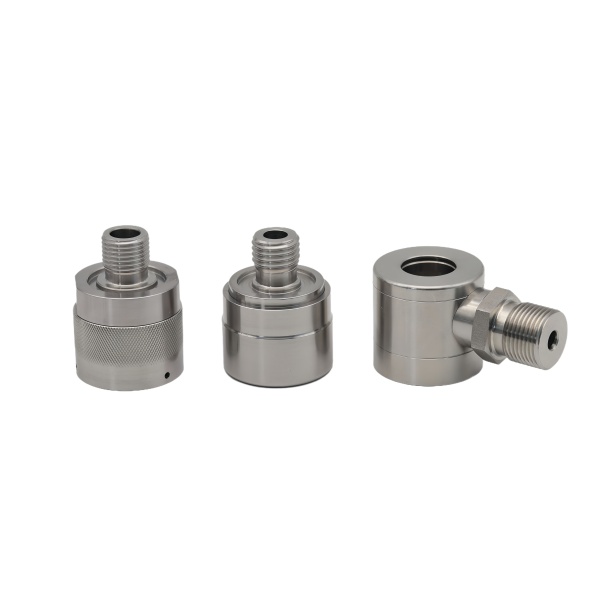
A cylinder body is usually specified by its bore, but the features that most often decide whether it survives assembly are the threaded ports cut into its wall. Every port removes metal from a pressure boundary, and it does so at the point where a fitting will later apply load. This page is about the ports: how much wall is left under them, where the threads sit relative to the bore, and what the sealing seat has to be.
A tapped port removes more wall than the drill that made it
The wall calculation that matters is the one after tapping, not after drilling. On a 5 mm wall, an M10 x 1.5 port tapped 15 mm deep takes roughly another millimetre out of the section at the thread major diameter, leaving about 4 mm. That is still workable. The problem is drill wander: 0.5 mm of deflection over a deep hole – ordinary in stainless steel, which work-hardens and pushes the drill – puts the minimum wall near 2.5 mm, and at half the nominal section the port may no longer contain the rated pressure. We calculate the remaining wall on the tapped feature with deflection allowed for, and where the sum comes out tight we add a boss rather than thinning the barrel.
Where the port axis sits decides whether the fitting seals
Ports are secondary operations, drilled and tapped after the bore is finished, and their position is held to the bore axis and the end face as datums. We work to a 0.2 mm diameter true-position zone at MMC for standard ports, tightening to 0.1 mm above M20 or 3/4 in BSP, where the fitting’s own weight and the hose it carries start to act as a lever on the thread. A port that is off position does not leak immediately – the fitting goes in and seals – but the thread then carries a bending load it was never sized for, and that is the port that cracks later.
The seat the fitting lands on has to be square to the thread
A port seals on a seat, not on the thread. Beyond M20 we spot-face the port so the sealing face is perpendicular to the port axis within 0.5 degrees, which is what allows a fitting to be torqued to specification without being bent into alignment by the hose behind it. Without the spot-face the fitting contacts on one edge of a drilled and tapped hole, and the joint either weeps or is over-tightened to make it stop – which on a stainless steel body risks galling the thread.
Thread form and galling in stainless steel
Stainless Steel is the reason these ports need more care than the same feature in steel. It work-hardens under the tap, it galls against a stainless steel fitting under load, and it conducts heat poorly enough that cutting heat stays in the tool. Thread form, tap selection and cutting speed are set for the grade rather than copied from a mild-steel job, and where a fitting will be removed more than once we flag it at quotation – a thread that will see repeated service is a different specification from one that will be assembled once.
How the ports are verified before the body leaves
Every port is checked on position and on the wall behind it, and the thread is gauged rather than eyeballed, because a port that assembles is not the same thing as a port that holds pressure.
First articles are retained for the programme, so a repeat order is machined to the same port positions, the same spot-faces and the same thread specification. On a body whose ports carry the pressure boundary, that is what keeps the second batch assembling like the first.
This part belongs to our CNC Machining range. The CNC pages collect the process notes, tolerancing practice and inspection points behind every product in the family.
Specifications
| Item | Stainless Steel CNC Machined Cylinders with Threaded Ports |
|---|---|
| Brand | AUNOV |
| Designing | Send the drawing, or a cylinder sample we can measure, the quotation comes back with a manufacturability review attached. |
| Tooling | Dies engineered and produced in our own toolroom, stored under your part number. |
| Samples | Sample parts arrive with a full dimensional report and mill certificate. |
| Materials | 304 / 316 stainless steel leads the stock list for this part, alongside carbon steel (SPCC / DC01), aluminium, brass and copper, and the grade is fixed at the drawing review. |
| Surface finish | Zinc, nickel or chrome plating, e-coat, powder coat, anodising or passivation, fixed at the drawing review. |
| Processing | Deep drawing in stages, in-line annealing where needed, with piercing and finish machining under the same roof. |
| Equipment | Our press floor runs 5-250 T mechanical and 250-500 T hydraulic presses, CNC cells plus a temperature-controlled CMM room. |
| Tolerance | Tolerances to +/-0.1 mm as drawn, machined features held to +/-0.03 mm. |
| Delivery terms | Prices FOB, with DDP for EU and US on request, T/T or L/C, D/P on repeat business, blanket orders and call-offs supported. |
Related Products


Request a Quote for This Part
Send a drawing or sketch — get material advice, tooling cost and a per-piece price within 24 hours (working days).