
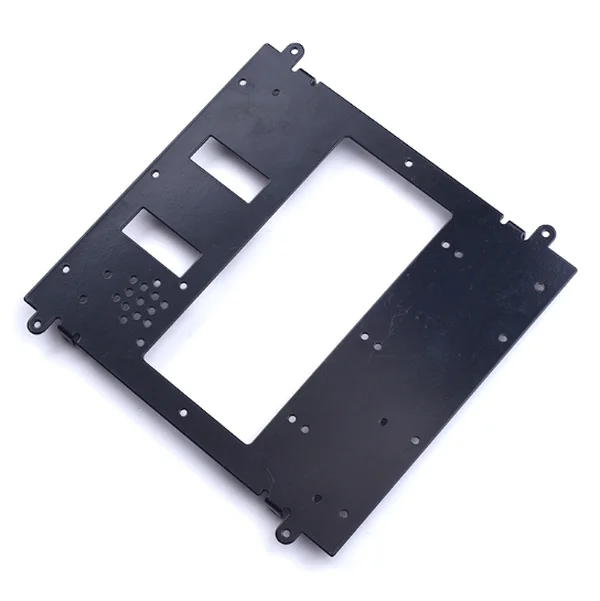
Black powder coat is specified as a colour and a film thickness, and those two numbers describe a fraction of what the coating actually does. A 70 micron powder film on a stamped panel frame is doing several jobs at once — corrosion protection, appearance, edge protection, and abrasion resistance — and each of them depends on properties of the coating that the thickness figure does not capture.
The most common failure on a powder coated part is not the wrong colour. It is a film that met the thickness specification and still failed, because adhesion or flexibility was never specified at all.
Film thickness is a range with a reason behind it
A stated 60 to 80 microns is not arbitrary. It reflects what the process can reliably achieve across the whole part, including the areas a spray gun reaches poorly.
- Thin areas occur on edges, on the inside of formed features, on wire edges and on surfaces facing away from the gun. On a panel frame the inside faces of the return flanges are the classic thin spot.
- Thick areas occur on horizontal upward-facing surfaces where powder can build, and in corners where the spray pattern overlaps.
- The measurement that matters is the minimum, not the average. An average reading on a thick spot tells you nothing about whether the thin areas will protect the part.
So the drawing should state where the measurement is taken and what the minimum is, not just the nominal. And on a frame with a lot of formed edges, specifying a higher minimum is often the correct answer rather than a concession.
Adhesion is the property that predicts field failure
Coating failure in service almost always begins at an interface, not in the middle of the film. A film that has delaminated from the substrate has failed even if it still looks intact and still measures the right thickness.
Adhesion is tested by cross-hatch — a set of parallel cuts through the film, a set of perpendicular cuts, and a tape pull — with a pass criterion based on how much coating lifts. This is a simple test that is routinely specified as “good adhesion” without stating the class, which makes it unenforceable.
What determines whether adhesion passes comes down to three things, and all three have to be right.
- Surface preparation. Oil, dust and especially mill scale will prevent adhesion outright. On a part with a drawing compound or a protective oil from the stamping operation, the pre-treatment has to be aggressive enough to remove it.
- Conversion layer or pre-treatment. Most powder systems need a chemical conversion layer — a phosphate, chromate or zirconium process — to create the bond. Without it, adhesion is mechanical only and it is marginal.
- Metal choice. Aluminium and galvanised steel need different systems from plain cold-rolled steel, and using the wrong one produces a coating that looks fine and peels off in a year.
Coating flexibility matters where the part is formed
This is the property most often omitted, and on a stamped frame it is important. A coating that is hard and adherent can still be brittle, and a brittle coating cracks when the substrate flexes or deforms.
- On a formed flange, if the flange flexes in service, the coating on the bend will crack first, and the cracks are where corrosion starts.
- On a fastener hole pattern, the deformation around the hole during assembly can crack the coating.
- On a panel that sees thermal cycling, the coating and the substrate expand differently, and a rigid coating puts the substrate into bending rather than letting it expand.
The test for this is a mandrel bend over a specified diameter, or an impact test. For a non-decorative functional coating on a part that will be handled, an impact test is the more informative of the two because it simulates what actually happens.
Powder versus wet paint, and why the choice matters for a frame
These are not equivalent, and the difference shows up in specific places.
- Coverage. Powder coats a flat that is dry and horizontal; wet paint wets it. On a vertical or downward-facing surface, powder can be thinner and rougher. On the inside of a formed return, this is the difference between acceptable and not.
- Edge and corner behaviour. Wet paint builds a wet film that levels and wraps edges. Powder is thrown at the edge and much of it falls off, so edges are thinner and less well covered.
- Repair. Both are repairable, but powder is easier to repair with powder and wet paint is easier to blend with wet paint. A part that will be scratched in service benefits from a system the local repair shop can match.
- Coating over a seam or a lap. Powder over a joint is thinner and can bridge; wet paint follows the joint better.
For a stamped panel frame with returns and a lot of formed edges, powder is entirely workable but the coverage on edges and inside corners has to be verified rather than assumed. This is a first-article check, not a production one, and it is done before the part is assembled.
The coating is on the part when it is assembled
A finished frame arrives and is then bolted, screwed or welded into something. That is a coating problem as much as an assembly problem.
- Fastener holes. A drilled hole through a coated surface cuts through the coating and exposes bare metal. If the fastener is dissimilar, that hole becomes a galvanic site. Where this matters, the holes should be masked before coating, or coated after assembly with a compatible material.
- Ground points. A frame that carries current needs bare contact surfaces — grounding straps, hinge knuckles, EMI bonds. Those surfaces must be masked, and the mask list is a design deliverable.
- Welded areas. A coating that is not removed before welding will contaminate the weld and the surrounding metal, and it will spatter. Masking a weld zone is standard and is often forgotten on a drawing.
- Clamping and seating faces. A coating on a seating face changes the assembled dimension by the film thickness and changes the friction at the joint.
The mask list is the single most valuable thing a coating drawing can carry, and it is consistently the thing most likely to be missing. It has to name the surfaces: masked, deliberately built up, or acceptance-critical on thickness.
Colour and appearance need an agreed reference
“RAL 9005 black” is not a complete specification, because RAL references a colour chip and real parts vary with batch, film thickness and lighting.
- Batch variation. A functional tolerance on colour — usually a Delta E value — is the enforceable form, and it needs an agreed measurement method and instrument.
- Gloss level. Same colour name, different gloss, and they look like different products. Gloss is specified on a scale with a measurement geometry.
- The viewing condition. A gloss value measured at 60 degrees and at 85 degrees are different numbers, and specifying which one matters.
- A physical reference part retained as an approved standard is worth more than any colour code, particularly where the part is assembled into a visible assembly with other coated parts.
On a panel frame that sits in a visible assembly, the appearance requirement is usually about matching other frames, and an approved sample from the first article is the only reliable reference.
Corrosion performance is a system property
A coated part’s corrosion resistance depends on the coating plus the pretreatment plus the coating’s own hole and defect population. This matters where the frame is outdoors or in a washdown.
- Pinholes and voids in the film are the dominant weakness. They come from surface contamination, from too thick a film, and from poor cure. On a part that sees a wet environment, a salt spray test on a first article is the only way to know.
- Coating thickness in crevices — inside a hem, at a closed section, under a return — determines whether the crevice is protected or traps water against bare metal.
- Edge coverage determines whether corrosion starts at the sheared edge, which is where it almost always starts.
So a corrosion requirement on a drawing should be stated as a test with a duration, not as a general claim. Salt spray hours, cyclic corrosion, or a soak test depending on the actual exposure.
Questions worth asking on a powder coated drawing
- Is the minimum film thickness stated separately from the nominal, and is the measurement location defined?
- Is adhesion specified as a cross-hatch class rather than as a general statement?
- Is flexibility or impact resistance specified, given that the part is formed and will be assembled?
- Are the grounding, seating and weld surfaces identified as masked?
- Are fastener holes coated, masked or coated after assembly — and does the drawing say which?
- Is colour specified with a Delta E tolerance and a gloss value with a measurement geometry?
- Is an approved first-article sample retained as the appearance reference?
- Where the part sees a wet environment, is a corrosion test specified with a duration?
The mask list question and the adhesion class question are the two that most often turn out to have been assumed rather than decided. Both cost nothing to settle on the drawing and both are expensive to settle after the first batch has been coated and rejected.
This part belongs to our Custom Metal Stamping Parts range. The custom metal stamping parts pages collect the process notes, common materials and inspection points behind every product in the family.
Specifications
| Item | Black Powder Coated Stamped Sheet Metal Panel Frame |
|---|---|
| Brand | AUNOV |
| Designing | Quoted from your print, not a catalogue – unusual walls, piercings or tolerances are feasibility-checked first, and revisions are re-quoted once rather than silently absorbed. |
| Tooling | Die, fixture and gauge work stays in our own toolroom, so the die charge is a separate, refundable quotation line, with ownership confirmed on the quotation. |
| Samples | Pre-production samples come with a full inspection report, so the powder coated stamped panel frame is proven before volume production, Production starts only after your written sign-off. |
| Materials | cold-rolled steel, 1.5 mm; mill certificate and heat-number traceability supplied with the first article. |
| Surface finish | black powder coat, 60-80 µm; alternatives quoted against the drawing. |
| Processing | progressive stamp + powder coat – a rectangular panel frame blanked and pierced in one progressive pass. |
| Equipment | Mechanical presses 5-250 T, in-press forming and piercing; secondary ops run on CNC turning centres, inspection on the CMM. |
| Tolerance | ±0.10 mm window opening; ±0.15 mm outer profile; critical dimensions 100% gauged. |
| Delivery terms | FOB Ningbo or Shanghai; T/T, L/C at sight or D/P; repeat orders reuse the approved first article. |
Related Products
Request a Quote for This Part
Send a drawing or sketch — get material advice, tooling cost and a per-piece price within 24 hours (working days).