
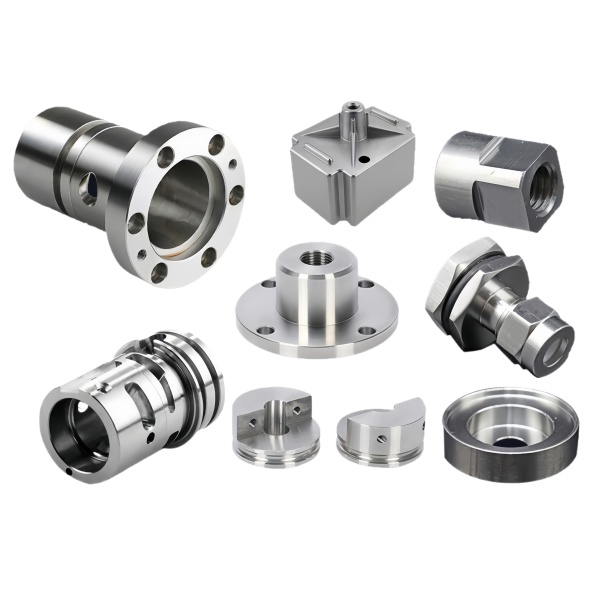
Stainless steel flanged fittings and nuts, turned from bar stock. Flange faces are faced flat and bolt holes are drilled to pattern, so these mate with standard pipework. Stainless means the fitting survives washdown and outdoor exposure.
Function and Design
A flanged fitting looks like the simplest item in a catalogue and is often the most demanding to make consistently. That is why the flanged fitting is inspected between operations, not only at the end.
What Makes It Work
- The flange doubles as a locating face and a sealing shoulder in a single piece.
- Corrosion resistance comes from the material itself, so washdown and humidity are handled.
- Repeat volumes are priced with in-house tooling and press capacity in mind.
- Material: stainless steel (304 / 316) – confirmed against your drawing before tooling, so the flanged fitting matches the print on the first batch.
- Process: the flanged fitting runs on CNC turning centres, critical faces finished in one setup, flange trimmed and pierced in-die.
- Finish: Surface treatment is chosen for the duty the flanged fitting sees: plated, coated or natural per print.
- Size: To print: flanged fitting diameters, depths and feature positions all follow the drawing.
- Custom: Custom production of the flanged fitting to print, MOQ set by the drawing rather than a catalogue.
Where It Is Used
It earns its place in automation and robotics hardware, instrumentation fittings, electronic and telecom enclosures.
Our Production Advantage
First articles are inspected on the CMM before a batch is released. Inspection is done in a climate-controlled room, and any dimension that drifts stops the machine rather than the shipment.
Ask for a quotation: flanged fitting material options, tolerances and tooling cost are confirmed in writing.